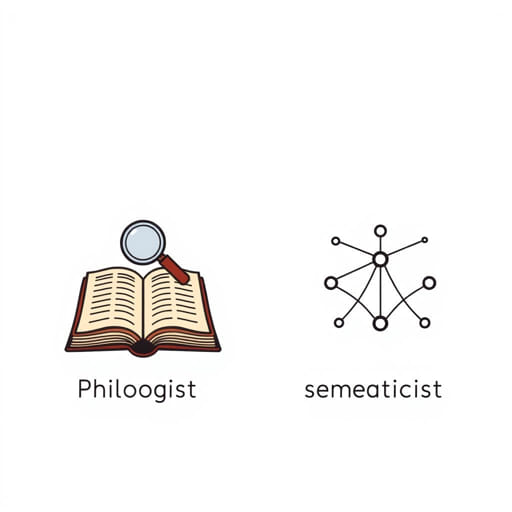
Understanding the distinctions between various linguistic fields can sometimes be confusing, especially when the terms sound similar or overlap in their subject matter. Two such terms that often cause confusion are ‘philologist’ and ‘semanticist.’ Both deal with language, but they focus on different aspects and approaches. This topic will explore the difference between a philologist and a semanticist, examining their definitions, areas of study, methodologies, and practical applications. By clarifying these roles, readers will gain a better appreciation of how each contributes to the study of language and meaning.
What is a Philologist?
A philologist is a scholar who studies language in written historical sources. Philology is often described as the study of language in written texts, combining aspects of linguistics, literary studies, history, and cultural studies. Philologists typically analyze ancient manuscripts, historical documents, and literary texts to understand the evolution of languages, cultural contexts, and meanings behind texts.
Core Focus Areas of Philology
- Historical Linguistics: Philologists examine how languages develop over time, tracking changes in grammar, vocabulary, and syntax.
- Textual Criticism: They compare different versions of manuscripts to establish original texts or identify errors introduced by scribes.
- Literary Analysis: Philologists study classical literature to understand cultural, historical, and philosophical contexts.
- Language Preservation: They often work with endangered languages or ancient scripts, helping to preserve knowledge that might otherwise be lost.
Philologists are often specialists in particular languages or language families, such as Latin, Greek, Sanskrit, or Old English. Their work involves deep knowledge of grammar, etymology, and historical context.
What is a Semanticist?
A semanticist is a specialist who studies semantics, the branch of linguistics concerned with meaning. Semantics explores how language conveys meaning through words, phrases, sentences, and larger discourse units. Unlike philologists, semanticists focus less on historical texts and more on how meaning is structured, interpreted, and communicated in language.
Core Focus Areas of Semantics
- Lexical Semantics: The study of word meanings and relationships, such as synonyms, antonyms, and homonyms.
- Compositional Semantics: How meanings of individual words combine to form meanings of phrases and sentences.
- Pragmatics: How context influences meaning beyond literal interpretations.
- Formal Semantics: Using logic and mathematical models to describe meaning precisely.
Semanticists work to understand how language users interpret meaning, resolve ambiguity, and convey intentions. Their research is relevant in linguistics, cognitive science, artificial intelligence, and language education.
Differences in Approach and Methodology
While both philologists and semanticists study language, their approaches and methods are distinct.
Philological Approach
- Historical and Cultural Context: Philologists analyze texts within their historical periods and cultural environments to extract meaning.
- Manuscript Analysis: Close examination of original or early versions of texts to trace linguistic and textual changes.
- Comparative Linguistics: Comparing languages or dialects to understand their development and relationships.
Semanticist Approach
- Language Structure and Meaning: Focus on how language elements encode meaning and how listeners interpret it.
- Abstract and Theoretical Models: Employ formal logic and models to represent semantic phenomena.
- Experimental and Cognitive Methods: Sometimes using psycholinguistics or computational tools to study meaning processing.
Practical Applications of Philology and Semantics
Both fields have practical applications, but in different domains.
Applications of Philology
- Preservation of Cultural Heritage: Restoring and understanding ancient texts contributes to cultural and historical knowledge.
- Language Revival: Philologists assist in revitalizing extinct or endangered languages.
- Text Editing and Translation: Producing accurate editions and translations of classical works.
- Historical Research: Providing insights into historical events and societies through language analysis.
Applications of Semantics
- Natural Language Processing (NLP): Semantic theories inform machine understanding of human language in AI systems.
- Language Teaching: Clarifying word meanings and usage to help learners grasp language nuances.
- Communication Studies: Improving clarity and reducing ambiguity in legal, medical, and everyday communication.
- Philosophy of Language: Addressing questions about meaning, reference, and truth.
Overlap and Collaboration
Although philologists and semanticists have distinct focuses, their work can overlap. For example, a philologist studying an ancient text may need to understand semantic shifts in word meanings to interpret the text accurately. Similarly, semanticists examining historical language change may draw on philological data.
Both fields contribute to the broader understanding of language as a human phenomenon, each from complementary angles. Their combined insights enrich disciplines like linguistics, literature, history, and cognitive science.
Summary of Key Differences
| Aspect | Philologist | Semanticist |
|---|---|---|
| Main Focus | Historical texts and language development | Meaning and interpretation of language |
| Primary Method | Textual analysis, historical context | Theoretical models, linguistic analysis |
| Typical Work | Editing manuscripts, language history | Studying word meanings, language processing |
| Applications | Language preservation, cultural history | AI, language education, communication |
The distinction between a philologist and a semanticist lies in their different approaches to studying language. A philologist focuses on historical texts, tracing the development and cultural context of languages, while a semanticist studies how meaning is constructed and interpreted in language. Both fields are essential to the comprehensive understanding of language, offering unique perspectives and methods. Recognizing their differences helps in appreciating the diverse ways language can be studied and applied in various academic and practical contexts.