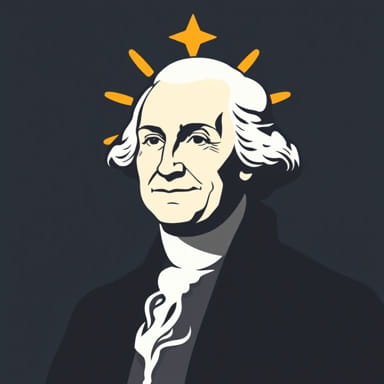
Among the many powerful expressions in early American history, few resonate with as much moral gravity and enduring influence as George Washington’s declaration: The propitious smiles of Heaven can never be expected on a nation that disregards the eternal rules of order and right. These words, delivered in Washington’s first presidential inaugural address in 1789, reveal more than just political philosophy. They reflect the deep connection between virtue, divine providence, and national destiny a worldview that guided the founding generation and defined the early American republic.
Context of the Inaugural Address
George Washington’s inauguration as the first President of the United States took place on April 30, 1789, in New York City. His address, delivered at Federal Hall, was brief but filled with humility, gratitude, and a sense of sacred duty. He began his presidency not with triumph, but with a sober reflection on the responsibilities of leading a new and fragile republic. Washington knew that the American experiment in self-government would only succeed with guidance, discipline, and a reliance on higher moral principles.
The Meaning Behind Propitious Smiles of Heaven
The phrase propitious smiles of Heaven symbolizes divine favor or blessings. Washington’s use of this phrase was not just poetic it was purposeful. He believed that the success of the United States depended on aligning national policies with what he called eternal rules of order and right. These were moral laws unwritten principles that transcended politics and were deeply rooted in religious tradition and philosophical reason.
Washington was not promoting any particular sect or church. Rather, he was invoking a broadly shared belief among Americans at the time that morality and religion were essential supports for a functioning republic. Without them, freedom could turn into chaos, and self-government could decay into tyranny.
George Washington’s Moral Vision for America
Throughout his life, Washington emphasized the importance of personal and public virtue. As both a military commander and a political leader, he believed that liberty must be tempered by responsibility. His reference to Heaven’s favor in his speech was a call to Americans to remain faithful not just to the Constitution, but to a higher moral code.
- Virtue in Public Life: Washington believed that leaders must exhibit moral integrity to earn the trust of the people and the favor of Providence.
- Religious Tolerance: While deeply religious, Washington valued freedom of belief and emphasized respect for diverse religious views as long as they promoted ethical behavior.
- National Responsibility: The quote suggests that collective morality matters not only individual virtue, but also the ethical direction of national policies and institutions.
The Role of Divine Providence in Washington’s Belief
One of the recurring themes in Washington’s writings and speeches was the role of divine providence. He often credited God with the victories of the Revolutionary War and the formation of the United States. To him, it was not human ingenuity alone that birthed the new nation. It was a miraculous series of events, guided by a divine hand.
By emphasizing the smiles of Heaven, Washington reminded citizens that their success could not be taken for granted. The American experiment would only endure if it remained faithful to moral principles and sought guidance beyond political convenience.
How Washington’s View Shaped American Identity
Washington’s vision helped shape a uniquely American sense of national purpose. He introduced the idea that the United States had a moral mission not just to secure freedom for its people, but to demonstrate that free societies could thrive if grounded in righteousness.
This idea deeply influenced the political discourse of the 19th century. Leaders from Abraham Lincoln to Frederick Douglass echoed similar sentiments, arguing that the nation’s promise would only be fulfilled if it aligned its laws with moral truth.
Legacy of the Phrase in Modern Times
Though often overlooked today, Washington’s words continue to resonate in debates about the role of religion, morality, and civic responsibility. The phrase propitious smiles of Heaven serves as a reminder that the founding of the United States was not only a political revolution but also a moral endeavor.
The phrase also continues to be cited in political speeches, classrooms, and religious discussions to underscore the importance of values-based leadership. It encourages reflection on whether modern society still respects the eternal rules of order and right that Washington believed essential for national survival.
Applications in Education and Civic Life
Many educators and historians use Washington’s address to teach students about the intersection of faith, philosophy, and governance in American history. His statement helps frame the larger question: Can a nation remain free if it loses its moral compass?
In civic discussions, especially in moments of crisis or division, Washington’s insight is revisited as a call for unity, ethics, and accountability. It serves as a grounding principle during times when the nation’s values seem at risk.
Why This Quote Still Matters
In today’s fast-changing and often polarized world, Washington’s inaugural message offers a timeless warning and a hopeful guide. His belief in the necessity of virtue, order, and divine favor reminds Americans that freedom is not self-sustaining. It requires effort, character, and commitment to ideals that transcend personal interest.
- It speaks to enduring values: Washington’s words link morality and governance, a theme that remains crucial in democratic societies.
- It invites civic reflection: Citizens are encouraged to ask whether their leaders, laws, and institutions align with higher principles.
- It reinforces national identity: The founding of the U.S. was not just a political act, but also a moral declaration.
George Washington’s reference to the propitious smiles of Heaven in his inaugural address is more than a poetic flourish it is a powerful statement about the conditions for liberty and the responsibilities of a free people. As the first president of a new republic, Washington knew that the durability of American democracy would depend on the virtue of its citizens and the moral foundation of its institutions.
By weaving together themes of divine providence, civic duty, and moral law, Washington established a standard for future generations. His words remain a cornerstone of American political thought and a reminder that freedom must always be anchored in right action and collective virtue.