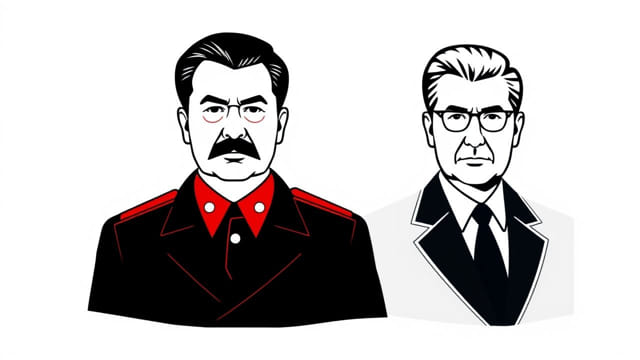
Leonid Brezhnev and Erich Honecker were two prominent political figures who played critical roles during the Cold War era, shaping the policies of the Soviet Union and East Germany respectively. Their leadership marked a period of stability and repression in their respective countries, and their alliance reflected the close ties between the Eastern Bloc states. Understanding who Brezhnev and Honecker were offers deep insights into the dynamics of Communist rule in Eastern Europe and the global political landscape during the second half of the 20th century.
Leonid Brezhnev: General Secretary of the Soviet Union
Rise to Power
Leonid Brezhnev was born on December 19, 1906, in Kamenskoye, Ukraine, then part of the Russian Empire. He joined the Communist Party in 1931 and gradually rose through the ranks due to his loyalty and administrative skills. After holding several regional positions, Brezhnev became closely associated with Nikita Khrushchev, eventually becoming a key figure in Soviet politics.
In 1964, following Khrushchev’s removal from power, Brezhnev became the First Secretary of the Communist Party, a position that was later renamed General Secretary. He remained in this role until his death in 1982, making him one of the longest-serving leaders in Soviet history.
Brezhnev Era Policies
Brezhnev’s time in power was characterized by what is often referred to as the ‘Era of Stagnation.’ Under his leadership, the Soviet Union maintained strict centralized control, and political dissent was harshly suppressed. Although the economy initially grew during the early years of his rule, it later suffered from inefficiencies and a lack of innovation.
Brezhnev also championed détente a policy aimed at easing tensions between the Soviet Union and the West. However, this was coupled with a strong military buildup and interventionist policies, such as the invasion of Afghanistan in 1979. These contradictory approaches reflected the complexities of Soviet foreign policy during his leadership.
Legacy and Influence
Leonid Brezhnev left behind a mixed legacy. He is remembered for providing a degree of stability following the turbulent years of Khrushchev, but also for presiding over a period of economic decline and political repression. His emphasis on heavy industry, military power, and ideological conformity helped maintain the Soviet Union’s superpower status but also planted the seeds for its eventual collapse.
Erich Honecker: Leader of East Germany
Background and Early Involvement
Erich Honecker was born on August 25, 1912, in Neunkirchen, in the German Empire. He joined the Communist Youth League at a young age and later studied at the International Lenin School in Moscow. Following World War II, Honecker quickly became a prominent figure in East Germany’s newly established Socialist Unity Party (SED).
He played a leading role in establishing the German Democratic Republic (GDR) as a Soviet-aligned state. Honecker’s involvement in the construction of the Berlin Wall in 1961 highlighted his commitment to maintaining the socialist system and preventing East Germans from fleeing to the West.
Leadership and Policies
In 1971, Erich Honecker replaced Walter Ulbricht as the head of the SED and became the de facto leader of East Germany. Under his rule, the GDR maintained a strict authoritarian regime with an extensive surveillance system operated by the Stasi, the infamous state security service. Political dissent was not tolerated, and the regime used propaganda and censorship to control public opinion.
Economically, Honecker sought to improve living standards and consumer goods availability, which he referred to as ‘unity of economic and social policy.’ While this initially brought some improvements, East Germany’s economy remained heavily dependent on the Soviet Union and became increasingly burdened by debt and inefficiency.
Relationship with the Soviet Union
Honecker’s leadership was deeply intertwined with the support of the Soviet Union, particularly under Brezhnev. The two leaders shared similar ideological goals and worked closely to maintain Communist control in their respective countries. Honecker was a strong advocate of the Warsaw Pact and a firm believer in the Brezhnev Doctrine, which justified Soviet intervention in any socialist state that was threatened by counter-revolutionary forces.
Despite his loyalty to Moscow, Honecker was reluctant to embrace the reforms introduced by Mikhail Gorbachev in the 1980s, such as glasnost and perestroika. His resistance to change eventually isolated him within the Eastern Bloc and contributed to his downfall in 1989.
Brezhnev and Honecker: Allies in the Eastern Bloc
Shared Goals and Ideologies
Both Leonid Brezhnev and Erich Honecker were staunch Communists who believed in the strength of centralized power, a planned economy, and the suppression of political opposition. They worked together to maintain the status quo in the Eastern Bloc, often using force to prevent liberalization or Western influence.
One of the most symbolic moments of their alliance was captured in a famous photograph of the two leaders kissing on the lips a traditional socialist greeting during the 30th anniversary of the GDR in 1979. This image came to represent the deep, albeit rigid, bond between the USSR and East Germany during the Cold War.
Impact on Cold War Politics
The relationship between Brezhnev and Honecker played a significant role in maintaining the cohesion of the Eastern Bloc during the 1970s and early 1980s. Their support for strict ideological control and opposition to reform discouraged any attempts at democratization or independence within satellite states.
However, their reluctance to modernize their political and economic systems also contributed to the stagnation and eventual crisis of socialism in Eastern Europe. When reform movements gained momentum in the late 1980s, both leaders’ legacies came under scrutiny as symbols of a failed system.
The Legacy of Two Cold War Leaders
Leonid Brezhnev and Erich Honecker were central figures in the Communist world during a critical period in 20th-century history. Brezhnev oversaw a powerful but increasingly fragile Soviet Union, while Honecker maintained one of the most tightly controlled states in the Eastern Bloc. Their leadership styles were marked by ideological rigidity, suppression of dissent, and a strong emphasis on loyalty to the socialist cause.
Although they initially brought stability to their nations, both leaders left behind systems that were ill-equipped to adapt to changing political and economic conditions. By the end of the 1980s, the reforms they resisted would reshape the world, bringing an end to the Cold War and the collapse of the regimes they once controlled. Their stories remain vital for understanding the complex nature of power, ideology, and resistance during one of the most tense periods in modern global history.