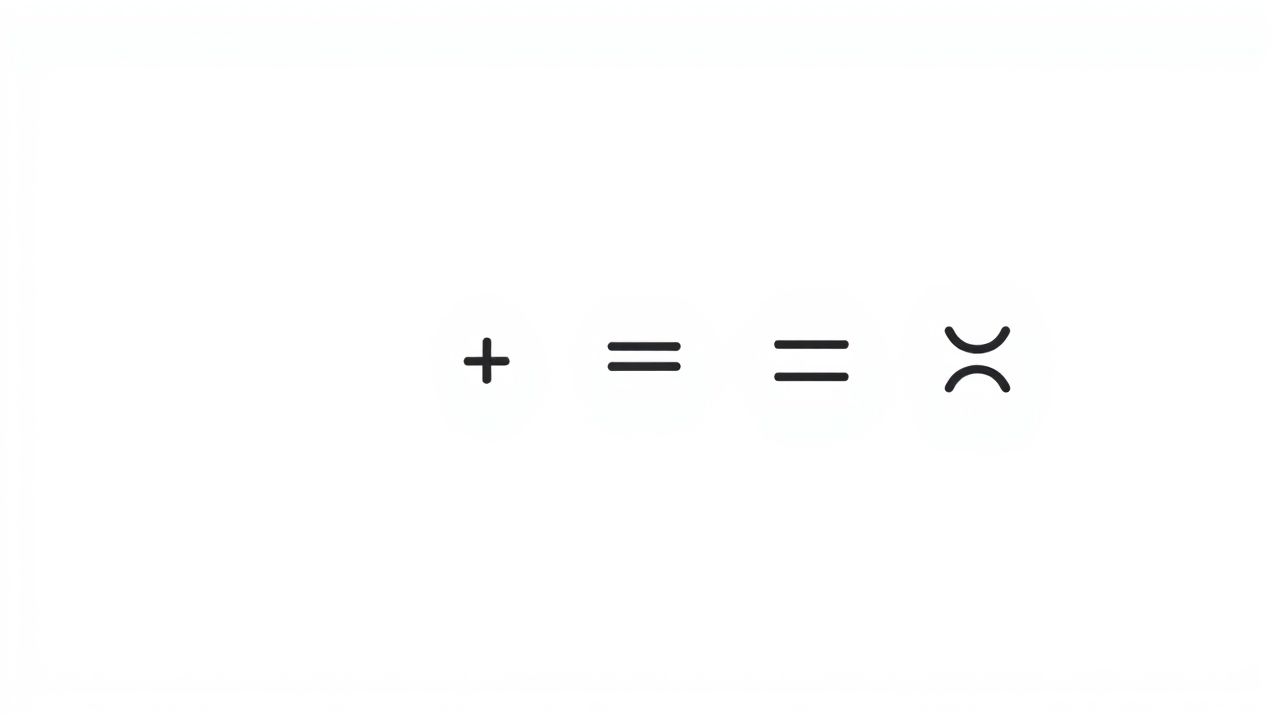
Mathematics has a natural hierarchy of operations that build upon one another, starting from the simplest form of combining quantities to extremely rapid growth patterns. This hierarchy begins with succession, followed by addition, multiplication, exponentiation, and then tetration. Each level can be seen as a repeated application of the previous one, creating a fascinating ladder of operations. Understanding how these operations relate to each other helps not only in arithmetic and algebra but also in advanced number theory, computer science, and even theoretical physics where growth rates and patterns matter greatly.
Succession
Succession is the most basic mathematical operation, referring to the idea of the next number” in counting. When you count 1, 2, 3, and so on, you are applying succession. It can be thought of as adding 1 to a number to get its successor.
Example of Succession
- The successor of 4 is 5.
- The successor of 10 is 11.
- Mathematically, successor(n) = n + 1.
This idea is the foundation of the natural numbers and is formally described in Peano arithmetic, which builds all other number operations starting from succession.
Addition
Addition is the process of combining two or more quantities. In the hierarchy, addition is repeated succession. For example, adding 3 to 5 means finding the number you reach after taking 3 successive steps forward from 5.
Properties of Addition
- Commutativea + b = b + a
- Associative(a + b) + c = a + (b + c)
- Identity elementa + 0 = a
Example of Repeated Succession
5 + 3 means Start at 5 â successor is 6 â successor is 7 â successor is 8.
Multiplication
Multiplication is repeated addition. If you multiply 4 by 3, it means adding 4 three times 4 + 4 + 4. This operation scales numbers more quickly than addition because it bundles additions together.
Properties of Multiplication
- Commutativea à b = b à a
- Associative(a à b) à c = a à (b à c)
- Identity elementa à 1 = a
- Distributive over additiona à (b + c) = a à b + a à c
Example of Repeated Addition
4 Ã 3 = 4 + 4 + 4 = 12.
Exponentiation
Exponentiation is repeated multiplication. For instance, 2³ means multiplying 2 by itself three times 2 à 2 à 2 = 8. This creates exponential growth, which increases much faster than addition or multiplication.
Properties of Exponentiation
- Not commutativea^b â b^a in general.
- Power of a power(a^b)^c = a^(b à c)
- Multiplication of powersa^b à a^c = a^(b + c)
- Identity elementa^1 = a
Example of Repeated Multiplication
3â´ = 3 Ã 3 Ã 3 Ã 3 = 81.
Tetration
Tetration is repeated exponentiation. It is less commonly encountered in everyday math but grows extraordinarily fast. Tetration of order n is written asa ââ n, meaningaraised to the power ofaraised to the power ofa, repeated n times.
Example of Tetration
2 ââ 3 = 2^(2^2) = 2^4 = 16.
3 ââ 2 = 3^3 = 27.
3 ââ 3 = 3^(3^3) = 3^27 = 7,625,597,484,987.
Properties of Tetration
- Not commutative and not associative.
- Grows faster than exponentiation, factorials, and polynomials.
- Used in certain areas of computational mathematics and large-number theory.
The Relationship Between the Operations
Each operation in this sequence is defined as a repetition of the previous one
- Succession add 1 repeatedly.
- Addition repeated succession.
- Multiplication repeated addition.
- Exponentiation repeated multiplication.
- Tetration repeated exponentiation.
This hierarchical pattern continues into even higher operations such as pentation, hexation, and beyond, though these are extremely rare in most mathematics outside of specialized research.
Practical Applications
Although tetration may seem abstract, the idea of operations building upon each other is very practical
- Successioncounting, indexing in programming.
- Additioneveryday calculations, basic finance.
- Multiplicationscaling recipes, computing areas.
- Exponentiationcompound interest, population growth, computing power.
- Tetrationmodeling extremely fast growth, exploring limits of computation.
Growth Rates and Comparisons
Growth speed increases drastically with each step in the hierarchy
- Succession linear increase, step by step.
- Addition still linear, but with larger steps.
- Multiplication polynomial growth.
- Exponentiation exponential growth.
- Tetration super-exponential growth.
For example, starting with the number 2
- Succession 2 â 3 â 4 â 5
- Addition by 2 2, 4, 6, 8
- Multiplication by 2 2, 4, 8, 16
- Exponentiation 2, 4, 16, 256
- Tetration 2, 4, 16, 65,536
The sequence from succession to tetration forms a natural ladder of mathematical operations, each one an iteration of the previous. While succession, addition, and multiplication are familiar from early education, exponentiation and tetration illustrate how rapidly numbers can grow when the process of repetition is applied at higher levels. Understanding these operations not only improves mathematical thinking but also offers insight into areas of science, engineering, and computation where growth rates and scaling play a central role. The beauty of this hierarchy lies in its simplicity at the base and its astonishing complexity at the top.