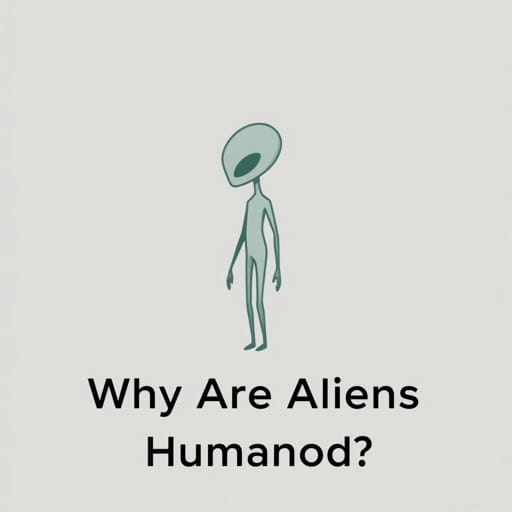
Throughout popular culture, aliens are often portrayed as humanoid beings two arms, two legs, upright posture, and facial features similar to humans. From science fiction movies to eyewitness reports of extraterrestrial encounters, the humanoid alien has become the dominant image of intelligent life beyond Earth. But why are aliens humanoid in so many depictions? The question invites us to explore biology, evolution, psychology, and even the way human imagination shapes how we expect other forms of life to appear. Understanding the reasons behind this recurring humanoid image reveals more about human nature than it does about actual extraterrestrial possibilities.
Biological Foundations of Humanoid Forms
One of the primary explanations for humanoid aliens lies in the concept of convergent evolution. Convergent evolution happens when different species, even if unrelated, evolve similar traits because they adapt to comparable environments. On Earth, for example, wings developed in both birds and bats independently. Similarly, if life exists elsewhere in the universe, it is possible that intelligent species could develop body structures that resemble ours if their environments are similar to Earth’s.
Advantages of Upright Posture
Walking upright has several evolutionary advantages. It frees the hands for tool use, enhances the ability to scan the environment for threats or opportunities, and supports efficient movement. These traits are strongly associated with intelligence and survival. If extraterrestrial life faced similar evolutionary pressures, they might also develop bipedal and upright forms, giving rise to humanoid aliens.
The Role of Hands and Dexterity
Hands capable of grasping and manipulating objects are crucial for building tools, using technology, and developing advanced civilizations. On Earth, human intelligence advanced rapidly due to the combination of brainpower and dexterous hands. This reasoning suggests that alien species might also evolve limbs suited for fine motor skills, making them look somewhat humanoid.
Psychological and Cultural Influences
The humanoid alien is not just a product of biology it is also shaped by human psychology. People naturally project familiar forms onto the unknown. Since humans only know one form of advanced intelligence themselves it is logical that aliens in human imagination often resemble us.
Anthropomorphism
Anthropomorphism, or the tendency to attribute human traits to non-human entities, plays a key role in alien depictions. Just as animals in folklore or animation often have human-like qualities, aliens are designed to look and act like humans to make them relatable. A humanoid alien is easier for audiences to understand, sympathize with, or fear.
Storytelling in Science Fiction
Science fiction films, television shows, and literature have long favored humanoid aliens for practical and narrative reasons. Early movies and TV series relied on human actors in costumes, making humanoid shapes the simplest option. Over time, these portrayals became ingrained in culture, reinforcing the expectation that aliens should look like us. From Star Trek” to countless other works, humanoid aliens dominate because they are cost-effective to depict and familiar to audiences.
Scientific Theories on Alien Intelligence
Beyond cultural imagination, some scientists argue that there may be logical reasons why extraterrestrials could be humanoid. Intelligence often requires a large brain, upright body, and the ability to manipulate the environment. These needs may naturally lead to certain physical similarities across intelligent species, even if they originate from vastly different worlds.
The Principle of Universality
Some astrobiologists suggest that the universe follows patterns that repeat themselves. Just as the laws of physics are universal, certain evolutionary outcomes may be common. If this principle holds true, intelligent beings might consistently evolve features such as forward-facing eyes for depth perception, legs for mobility, and hands for interaction. This would increase the likelihood of aliens being humanoid.
Environmental Similarities
If other planets have conditions resembling Earth gravity levels, breathable atmospheres, and similar resources alien life could evolve under pressures comparable to those that shaped humans. This possibility strengthens the argument that humanoid aliens may not only be a cultural invention but also a scientific probability.
Why Humanoid Aliens Dominate Popular Culture
In addition to biology and science, the dominance of humanoid aliens reflects cultural needs. Storytelling thrives on relatability, and audiences more easily connect with aliens who walk, talk, and think in ways resembling humans. A completely foreign being might be scientifically accurate but emotionally distant and harder to portray in stories.
- Humanoid aliens allow filmmakers to use human actors in costumes.
- They create relatable characters for audiences to understand motives and emotions.
- They reflect human hopes and fears by acting as mirrors of ourselves.
The Symbolism of Humanoid Aliens
Humanoid aliens often serve as symbols in science fiction. They might represent alternate versions of humanity, embodying qualities such as wisdom, aggression, or spirituality. By presenting aliens as similar yet different, creators use them to explore philosophical and ethical questions about human society. This symbolic function makes humanoid aliens particularly valuable in storytelling.
Alternative Alien Forms
Although humanoid aliens dominate cultural imagination, it is important to recognize that extraterrestrial life could take many other forms. Some scientists argue that expecting humanoid aliens reflects a narrow perspective, and that alien life could be radically different from anything on Earth. For instance, they might be silicon-based instead of carbon-based, exist in liquid or gaseous states, or lack any recognizable body structure.
Non-Humanoid Possibilities
Alternative alien forms could include
- Insect-like species with multiple limbs and compound eyes.
- Amorphous life forms resembling jellyfish or slime molds.
- Machine-based or artificial intelligence life forms with no organic body.
- Energy-based entities without a fixed physical shape.
These possibilities challenge the humanoid image and remind us that the universe may hold far more diversity than our imaginations often depict.
The Role of Human Imagination
Ultimately, the humanoid alien exists at the crossroads of science, psychology, and creativity. While convergent evolution and environmental similarities might make humanoid extraterrestrials plausible, it is also true that human imagination shapes them into forms we can recognize. They reflect not only scientific possibilities but also cultural anxieties, desires, and the limits of our perspective.
Aliens are often humanoid because humans use themselves as the template for imagining intelligent life. Biology provides some support through convergent evolution and environmental pressures, while psychology explains our tendency to anthropomorphize the unknown. Cultural storytelling further reinforces the image of humanoid aliens as both relatable and symbolic. Yet the vastness of the universe suggests that real extraterrestrial life, if it exists, may be much stranger than we expect. The question of why aliens are humanoid ultimately reveals how humans project their own image onto the stars, blending science with imagination in a search to understand our place in the cosmos.