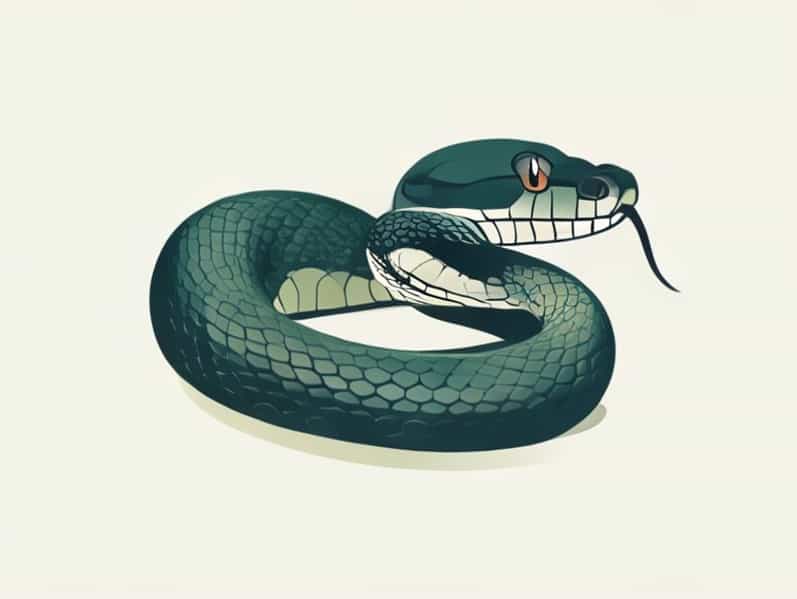
People living near rivers, swamps, and lakes in the southeastern United States often hear the term water snake used for many different snakes seen near water. This leads to a very common and important question is a cottonmouth a water snake? The confusion is understandable because cottonmouths spend a lot of time in or around water and share habitats with other nonvenomous water snakes. Knowing the difference is not just interesting, it can also be important for safety, wildlife awareness, and appreciation of nature.
Understanding the Term Water Snake
The phrase water snake is not a scientific term. Instead, it is a general label people use to describe snakes that live in or near water. This can include several species from different snake families.
In North America, water snakes usually refer to nonvenomous snakes from the genus Nerodia. These snakes are commonly seen swimming, basking on branches over water, or hunting fish and amphibians.
Common Characteristics of Water Snakes
- Nonvenomous
- Strong swimmers
- Often mistaken for venomous species
- Found near freshwater habitats
What Is a Cottonmouth Snake
A cottonmouth, also known as a water moccasin, is a venomous snake native to the southeastern United States. Its scientific name is Agkistrodon piscivorus.
Cottonmouths belong to the pit viper family, which also includes rattlesnakes and copperheads. They are well adapted to both aquatic and terrestrial environments.
Why It Is Called a Cottonmouth
The name comes from the snake’s defensive behavior. When threatened, it opens its mouth wide to reveal the white interior, which resembles cotton.
This display serves as a warning to potential predators or threats.
Is a Cottonmouth a Water Snake
From a scientific standpoint, a cottonmouth is not a water snake in the traditional sense. It does not belong to the Nerodia genus, which includes true water snakes.
However, cottonmouths are semi-aquatic and spend much of their time in water. Because of this, many people casually call them water snakes.
The Source of Confusion
The confusion exists because both cottonmouths and nonvenomous water snakes share similar habitats and behaviors.
They may be seen swimming, floating, or resting near water, which makes quick identification difficult.
Physical Differences Between Cottonmouths and Water Snakes
Learning the physical differences can help people distinguish between a cottonmouth and a nonvenomous water snake.
Head Shape
Cottonmouths have a broad, triangular head typical of pit vipers. Their neck is noticeably thinner than their head.
Water snakes tend to have narrower heads that are less distinct from the neck.
Eye Appearance
Cottonmouths have vertical, cat-like pupils. Water snakes have round pupils.
This feature is one of the more reliable identification clues, though it can be hard to see from a distance.
Body Pattern and Color
Cottonmouths often have darker, less distinct patterns, especially as they age. Older individuals may appear almost solid dark brown or black.
Water snakes usually have clearer banding or blotches and often appear more patterned.
Behavioral Differences
Behavior can also offer clues when asking whether a cottonmouth is a water snake.
Defensive Behavior
Cottonmouths are known for standing their ground. When threatened, they may coil, open their mouth, and display the white interior.
Water snakes are more likely to flee quickly into the water when approached.
Swimming Style
Cottonmouths often swim with much of their body floating on the surface of the water.
Water snakes usually swim with most of their body submerged, with only the head visible.
Habitat Preferences
Both cottonmouths and water snakes prefer wet environments, but there are subtle differences.
Cottonmouth Habitats
Cottonmouths are commonly found in swamps, marshes, slow-moving streams, ponds, and lakes.
They may also travel over land to reach new water sources.
Water Snake Habitats
Nonvenomous water snakes prefer similar aquatic habitats but are more often associated with freshwater systems like rivers and creeks.
They are less likely to venture far from water.
Diet and Hunting Behavior
Both cottonmouths and water snakes are opportunistic predators.
Cottonmouth Diet
Cottonmouths eat fish, frogs, small mammals, birds, and even other snakes.
Their venom helps them subdue prey efficiently.
Water Snake Diet
Water snakes primarily feed on fish and amphibians.
They rely on constriction rather than venom.
Venom and Safety Concerns
This is one of the most important differences when asking if a cottonmouth is a water snake.
Cottonmouths are venomous and capable of delivering a medically significant bite.
Water Snakes Are Nonvenomous
Nonvenomous water snakes may bite if handled, but they do not have venom.
Their bites are generally harmless and heal easily.
Geographic Range
Cottonmouths are primarily found in the southeastern United States.
Water snakes have a wider distribution across much of North America.
Role in the Ecosystem
Both cottonmouths and water snakes play important roles in their ecosystems.
They help control populations of fish, amphibians, and small animals.
Ecological Importance
- Maintain balance in aquatic ecosystems
- Serve as prey for birds and mammals
- Indicate healthy wetland environments
Why Misidentification Is Common
Fear, quick encounters, and similar appearances contribute to frequent misidentification.
Many harmless water snakes are killed each year due to being mistaken for cottonmouths.
How to Stay Safe Around Snakes
When near water, it is best to assume any snake could be venomous and keep a safe distance.
Do not attempt to handle or provoke snakes.
Basic Safety Tips
- Watch where you step near water
- Give snakes plenty of space
- Do not attempt identification up close
- Educate yourself on local species
Common Myths About Cottonmouths
One common myth is that cottonmouths aggressively chase people. In reality, they prefer to avoid conflict.
Most defensive displays occur when the snake feels cornered.
Educational Value of Understanding the Difference
Learning whether a cottonmouth is a water snake encourages respect for wildlife and reduces unnecessary fear.
It also promotes conservation by protecting nonvenomous species.
Summary of Key Differences
- Cottonmouths are venomous pit vipers
- Water snakes are nonvenomous
- Both live near water but belong to different families
- Physical and behavioral traits help with identification
So, is a cottonmouth a water snake? Scientifically, the answer is no. A cottonmouth is a venomous pit viper, while water snakes are nonvenomous members of a different snake family. However, because cottonmouths live near water and behave like aquatic snakes, they are often casually referred to as water snakes. Understanding the difference helps people stay safe, respect wildlife, and appreciate the diversity of snakes that share our waterways. Knowledge replaces fear and allows for coexistence with these fascinating reptiles.