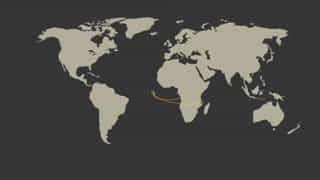
In the early 16th century, the world was still largely uncharted, with oceans separating empires and continents from one another. It was during this age of exploration that Ferdinand Magellan, a Portuguese navigator sailing under the Spanish crown, undertook one of the most significant maritime expeditions in human history. His voyage around the world was not only a test of endurance and maritime skill but also a transformational event that altered the global map forever. A map of Magellan’s voyage reveals more than just geographic routes; it tells a story of ambition, discovery, conflict, and the first recorded circumnavigation of the Earth.
Background of Magellan’s Expedition
The Drive for Spices and Trade
During the Age of Exploration, European powers were in a race to discover new trade routes to the East Indies, the region known for its valuable spices like cloves, nutmeg, and cinnamon. At the time, the Portuguese had control over the eastern maritime routes around Africa to Asia. Ferdinand Magellan believed he could find a western passage to the Spice Islands (modern-day Maluku Islands, Indonesia) by sailing around the southern tip of the Americas.
Backing from Spain
Rejected by the Portuguese crown, Magellan offered his services to King Charles I of Spain. The Spanish monarch agreed to sponsor the expedition in hopes of bypassing Portuguese control and establishing Spain’s own trade route to the East. Magellan’s fleet of five ships Trinidad, San Antonio, Concepción, Victoria, and Santiago set sail from Seville in September 1519.
Route of Magellan’s Voyage
Atlantic Ocean to South America
After leaving Seville, Magellan’s fleet navigated down the Guadalquivir River and into the Atlantic Ocean. They made stops along the west coast of Africa and continued across the Atlantic to South America. By December 1519, they reached the coast of modern-day Brazil. The fleet spent the southern winter along the South American coast, enduring storms and dwindling supplies.
Discovery of the Strait of Magellan
In October 1520, Magellan discovered a passage through the southern tip of South America, now known as the Strait of Magellan. This narrow and treacherous waterway allowed the fleet to pass from the Atlantic to the Pacific Ocean. It was a defining moment of the expedition, demonstrating that a western route to Asia was possible. The strait was both a geographical breakthrough and a dangerous gamble, taking over a month to navigate successfully.
The Vast Pacific Crossing
Once through the strait, the expedition entered the Pacific Ocean, a name Magellan himself bestowed due to its calm waters at the time. However, the crossing proved far from peaceful. The journey across the Pacific was marked by starvation, scurvy, and despair. The map of Magellan’s voyage shows a long, seemingly endless stretch across the Pacific, highlighting the sheer scale of this endeavor. The ships did not see land for over three months until they reached the islands of Guam and later the Philippines.
Arrival in the Philippines and Magellan’s Death
Interaction with Local Tribes
In March 1521, the expedition landed in the Philippines. Magellan established relations with several local leaders, converting some to Christianity. However, his involvement in local tribal disputes proved fatal. On April 27, 1521, Magellan was killed in the Battle of Mactan, led by the local chieftain Lapu-Lapu. Though Magellan never completed the voyage himself, his leadership had brought the fleet most of the way around the globe.
Leadership After Magellan
After Magellan’s death, leadership passed to Juan Sebastián Elcano. Under his command, the remaining ships continued to the Spice Islands. Only one ship, the Victoria, managed to return to Spain, completing the first circumnavigation of the globe in September 1522. Of the original 270 crew members, only 18 survived the journey.
Mapping the Circumnavigation
Geographical Importance
The map of Magellan’s voyage spans multiple continents and oceans. Starting in Europe, it extends across the Atlantic, cuts through South America via the Strait of Magellan, stretches across the vast Pacific, reaches Southeast Asia, and loops back around Africa to return to Spain. This route provided the first practical proof that the Earth is round and could be circumnavigated by sea.
Key Locations on the Map
- Seville, Spain– The starting and ending point of the expedition.
- Rio de Janeiro, Brazil– An early stop for resupply.
- Strait of Magellan– The critical passage from the Atlantic to the Pacific.
- Guam and the Philippines– Sites of significant encounters and events.
- Spice Islands– The goal of the entire expedition.
- Cape of Good Hope, Africa– The southern tip of Africa on the return route.
Consequences and Legacy
Scientific and Geographic Impact
Magellan’s voyage proved that the Earth was indeed round and far larger than previously estimated. The mapping of new territories opened up a new chapter in global navigation and commerce. Although not accurate by modern standards, maps drawn based on this voyage significantly enhanced Europe’s understanding of world geography.
Colonial and Cultural Influence
The expedition opened the door to Spanish colonization in the Pacific and Asia, particularly in the Philippines. Cultural and religious impacts from this contact would shape these regions for centuries. The voyage also challenged European perceptions of distance, trade, and global power dynamics.
Recognition of Juan Sebastián Elcano
While Magellan is often credited with the circumnavigation, it was Elcano who brought the mission to completion. His name is remembered in history, but Magellan’s leadership in navigating previously uncharted waters made him the enduring symbol of the expedition. Modern commemorations often highlight both figures as essential to the success of the journey.
The map of Magellan’s voyage tells more than the story of one man’s journey; it represents a pivotal moment in world history. It marked the beginning of global exploration that would connect continents through trade, conquest, and cultural exchange. The perils faced and discoveries made during this epic journey laid the groundwork for the modern world’s understanding of geography and navigation. For those interested in the history of exploration, the route Magellan pioneered remains a testament to the power of human curiosity and determination.