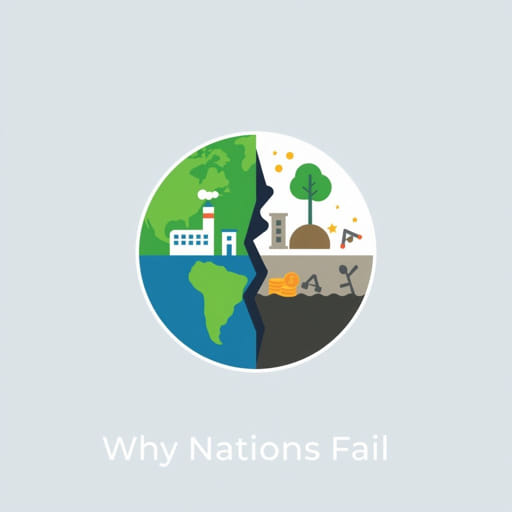
Why do some nations thrive while others remain trapped in poverty and instability? This fundamental question has long intrigued economists, historians, and political scientists alike. The bookWhy Nations Fail, written by Daron Acemoglu and James A. Robinson, offers a compelling and research-backed explanation grounded in the roles of political and economic institutions. Rather than focusing solely on geography, culture, or ignorance, the authors argue that inclusive institutions foster prosperity while extractive institutions lead to stagnation and decline. The book has ignited widespread discussion and continues to influence debates around global inequality, economic development, and governance.
Overview of the Book
Authors and Background
Daron Acemoglu, an economist at MIT, and James A. Robinson, a political scientist, bring decades of research into institutional development and political economy. Their combined expertise enables a multidisciplinary perspective that blends economics, history, and politics.
Main Thesis
The central thesis ofWhy Nations Failis that inclusive institutions those that provide a level playing field, uphold the rule of law, and allow for broad political participation lead to sustained economic growth. In contrast, extractive institutions concentrate power and wealth in the hands of a few, limiting innovation and reducing incentives for productivity.
Key Concepts and Ideas
Inclusive vs. Extractive Institutions
One of the book’s core ideas revolves around the nature of institutions:
- Inclusive institutions: Encourage participation in economic and political life. They are characterized by secure property rights, open markets, and transparent governance.
- Extractive institutions: Limit access to economic and political resources. These systems are designed to benefit a small elite at the expense of the broader population.
This distinction explains why countries with similar geographic or cultural backgrounds can experience drastically different development outcomes.
The Role of Political Power
Acemoglu and Robinson argue that political centralization and inclusive political institutions are essential. Political institutions shape economic ones, and without inclusive politics, inclusive economic institutions cannot survive. Nations fail when political power is monopolized and used to create and maintain extractive institutions.
Critical Junctures
History is filled with turning points, or critical junctures, that change the trajectory of a nation. The authors highlight how different countries respond to these moments determines their long-term institutional paths. A classic example is the Industrial Revolution, which was embraced in some parts of the world but resisted in others due to entrenched elite interests.
Case Studies in the Book
North and South Korea
The stark contrast between North and South Korea is frequently cited inWhy Nations Fail. Despite sharing the same cultural and geographic background, the two nations took different paths after the Korean War. South Korea developed inclusive economic and political institutions, while North Korea remained under a centralized, authoritarian regime. As a result, South Korea became a global economic powerhouse, while North Korea struggled with poverty and isolation.
Colonial Latin America
The book explores how colonial powers set up extractive institutions in Latin America. The Spanish crown established systems that exploited indigenous populations and concentrated land and resources in the hands of a few. These patterns continued post-independence, contributing to persistent inequality and underdevelopment.
The United States
The United States is portrayed as a country that benefited from inclusive institutions early in its history. The relatively egalitarian structure of its colonies and the inclusive nature of its political evolution allowed it to develop strong economic foundations. However, the book also warns of the potential for institutional decay even in prosperous nations.
Criticisms and Debates
Geographic and Cultural Counterarguments
Some critics argue that geography, natural resources, or cultural values play a greater role than the authors acknowledge. Others point out that some countries with extractive institutions have achieved growth, at least temporarily, challenging the thesis that inclusivity is the only path to development.
China as a Counterexample
China’s rapid economic growth under authoritarian rule presents a challenge to the book’s framework. While China lacks inclusive political institutions, it has achieved significant economic gains. Acemoglu and Robinson acknowledge this anomaly but caution that without political reform, such growth is unsustainable.
Oversimplification Concerns
Another critique is that the book may oversimplify complex historical and political dynamics. While the institutional framework is compelling, development is influenced by many interacting factors, and not all outcomes can be attributed solely to institutional design.
Implications for Policy and Development
Building Inclusive Institutions
For nations seeking long-term prosperity, the message is clear: foster inclusive political and economic systems. This means ensuring fair elections, protecting property rights, reducing corruption, and encouraging entrepreneurship.
The Role of International Aid
The authors argue that foreign aid is often ineffective when it supports extractive institutions. Instead, development strategies should focus on promoting institutional reform and empowering citizens.
Institutional Drift and Vigilance
Even nations with strong institutions are not immune to backsliding. The book highlights the importance of civic engagement, accountability, and checks and balances to maintain institutional integrity over time.
Why Nations Failoffers a thought-provoking and well-researched explanation for global inequality and development disparities. Its focus on institutions as the driving force behind prosperity and failure challenges conventional wisdom and encourages a reevaluation of how societies are structured. The distinction between inclusive and extractive institutions provides a powerful lens through which to understand historical outcomes and future potential. While not without its critics, the book continues to shape conversations in economics, politics, and development policy. For readers seeking to understand why some nations rise while others fall behind, this book is an essential resource and a compelling call to action for institutional reform and inclusive governance.