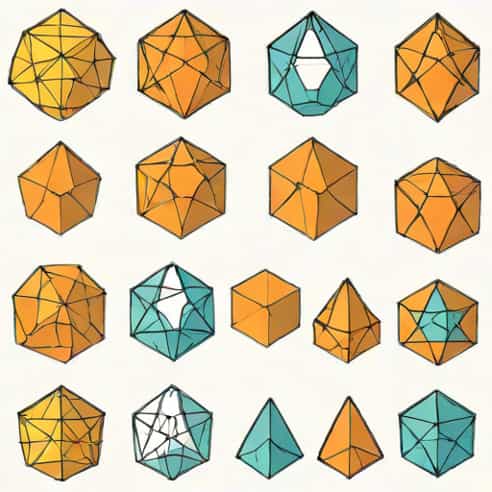
Understanding the difference between polygonal and polyhedral shapes is fundamental in geometry, architecture, and various engineering disciplines. While both terms relate to figures with multiple sides, they differ significantly in dimensions, properties, and applications. Polygonal shapes are two-dimensional figures with straight edges, while polyhedral shapes extend into three dimensions with flat faces, edges, and vertices. Recognizing these distinctions is important for students, designers, and professionals working with geometric forms, as it influences calculations, visualizations, and practical implementations. Exploring their definitions, characteristics, and examples provides clarity on how these concepts are applied in real-world contexts.
Definition of Polygonal Shapes
A polygonal shape, or polygon, is a flat, two-dimensional geometric figure composed of a finite number of straight line segments connected end-to-end to form a closed figure. Each line segment represents a side, and the points where the sides meet are called vertices. Polygons can vary in complexity from simple triangles and quadrilaterals to complex decagons and beyond. The key feature of polygons is that they exist only in a single plane and do not possess volume or thickness.
Key Features of Polygonal Shapes
- Two-dimensional (2D) figures
- Closed shape with straight edges
- Composed of sides and vertices
- No volume or depth
- Can be regular (all sides and angles equal) or irregular
Definition of Polyhedral Shapes
Polyhedral shapes, or polyhedra, are three-dimensional solid figures composed of flat polygonal faces, straight edges, and vertices. Each face of a polyhedron is a polygon, and the edges are the line segments where two faces meet. Polyhedra are widely studied in geometry due to their structural and spatial properties, which are essential for architecture, 3D modeling, and crystallography. Unlike polygons, polyhedra occupy space and have measurable volume and surface area.
Key Features of Polyhedral Shapes
- Three-dimensional (3D) figures
- Composed of flat polygonal faces
- Edges where faces meet and vertices at the corners
- Have volume and surface area
- Can be regular (like a cube) or irregular
Differences Between Polygonal and Polyhedral
The primary difference between polygonal and polyhedral shapes lies in their dimensionality and structural properties. Polygonal shapes are confined to two dimensions, while polyhedral shapes extend into three dimensions. This distinction affects not only their geometric characteristics but also how they are used in various fields.
Dimensional Differences
Polygonal shapes exist in a plane and are defined by their perimeter and interior angles. Polyhedral shapes, on the other hand, occupy space and are defined by faces, edges, vertices, volume, and surface area. This dimensional difference makes polyhedra more complex and applicable in physical modeling, engineering, and architecture.
Structural Differences
Polygons consist solely of sides and vertices, forming a flat enclosure. Polyhedra consist of multiple polygonal faces connected at edges and vertices to form a solid structure. For example, a triangle is a simple polygon with three sides, while a tetrahedron is a polyhedron with four triangular faces. The structural complexity of polyhedra allows for diverse applications in 3D design and construction.
Mathematical Properties
Polygons are analyzed using formulas related to angles, perimeter, and area. Polyhedra require more complex calculations, including surface area and volume formulas. Euler’s formula, which relates vertices, edges, and faces (V – E + F = 2), is specific to convex polyhedra and highlights the unique properties of three-dimensional solids. This mathematical distinction is essential for both theoretical studies and practical applications.
Examples of Polygonal Shapes
Polygonal shapes are common in everyday life, art, and design. Simple examples include
- Triangle – three sides, three vertices
- Square – four equal sides, four vertices
- Pentagon – five sides, five vertices
- Hexagon – six sides, often seen in honeycomb patterns
- Octagon – eight sides, common in stop signs
These shapes are primarily two-dimensional, used for tiling, graphic design, and basic geometric analysis.
Examples of Polyhedral Shapes
Polyhedral shapes are three-dimensional and can be seen in natural formations, architecture, and manufactured objects. Examples include
- Cube – six square faces, twelve edges, eight vertices
- Tetrahedron – four triangular faces, six edges, four vertices
- Octahedron – eight triangular faces, twelve edges, six vertices
- Dodecahedron – twelve pentagonal faces, thirty edges, twenty vertices
- Icosahedron – twenty triangular faces, thirty edges, twelve vertices
These polyhedra are studied in geometry for their symmetry, stability, and aesthetic properties and are frequently used in 3D modeling, gaming, and structural design.
Applications in Real Life
Understanding the distinction between polygonal and polyhedral shapes has practical applications across multiple fields. In architecture, polygonal designs are used in floor plans, windows, and decorative motifs, while polyhedral structures provide three-dimensional frameworks for buildings, sculptures, and domes. In mathematics and science, polygons are fundamental in planar geometry, whereas polyhedra are essential for studying crystals, molecular structures, and spatial reasoning. Even in computer graphics and 3D modeling, polygonal meshes form the basis of polyhedral representations, linking both concepts in modern technology.
Educational Importance
Teaching the difference between polygonal and polyhedral shapes helps students develop spatial reasoning and geometric understanding. By examining how flat shapes form three-dimensional solids, learners can better appreciate concepts like volume, surface area, and symmetry. This knowledge also supports advanced studies in mathematics, physics, engineering, and design.
In summary, polygonal and polyhedral shapes are foundational concepts in geometry, with distinct characteristics and applications. Polygonal shapes are two-dimensional, consisting of sides and vertices and used primarily in flat designs and planar calculations. Polyhedral shapes are three-dimensional solids composed of polygonal faces, edges, and vertices, with measurable volume and surface area, serving important roles in architecture, science, and 3D modeling. Understanding these differences allows students, professionals, and enthusiasts to accurately identify, analyze, and apply geometric concepts across various disciplines. By exploring examples, mathematical properties, and real-life applications, the distinction between polygonal and polyhedral shapes becomes clear, reinforcing their relevance in both theoretical and practical contexts.
Mastering the knowledge of polygonal versus polyhedral shapes not only strengthens geometric literacy but also enhances problem-solving and design capabilities. Whether creating architectural structures, analyzing molecular formations, or engaging in mathematical reasoning, recognizing the differences between these two types of geometric forms is essential for accurate analysis and creative innovation.