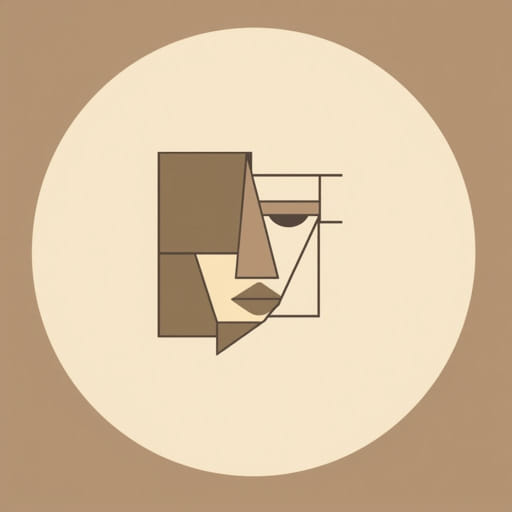
Cubism began as a revolutionary approach to visual art that broke away from traditional methods of representation. Rather than depicting subjects from a single point of view, Cubism offered multiple perspectives simultaneously, allowing artists to reimagine space, form, and dimension. This groundbreaking movement challenged the realism of earlier art and opened the door to abstraction. The origins of Cubism are deeply rooted in the early 20th century, emerging during a time of rapid innovation and shifting cultural values in Europe. Understanding how Cubism started requires exploring its historical context, key contributors, and philosophical foundations.
Historical Context of Cubism
Art at the Turn of the Century
In the early 1900s, the art world was undergoing dramatic changes. Impressionism and Post-Impressionism had already pushed the boundaries of how light, color, and emotion could be expressed on canvas. Artists like Claude Monet, Vincent van Gogh, and Paul Cézanne had introduced new techniques and ideas that deviated from academic standards.
It was within this climate of experimentation that Cubism emerged. Artists began questioning the nature of visual perception and sought ways to move beyond the naturalistic representation that had dominated European painting since the Renaissance. The need to express more complex realities gave rise to a new way of seeing.
The Influence of Paul Cézanne
Paul Cézanne is often cited as a major influence on the birth of Cubism. Though not a Cubist himself, Cézanne’s later works featured simplified forms and geometric structures. He suggested that all nature could be reduced to the cylinder, the sphere, and the cone. His approach to structure and spatial distortion inspired younger artists to explore similar visual deconstructions.
By breaking down natural forms into basic shapes and flattening perspective, Cézanne laid the groundwork for the analytical processes that would define early Cubist painting. His belief that art should depict the underlying order of nature strongly resonated with artists who were dissatisfied with surface appearances.
Pablo Picasso and Georges Braque: The Pioneers
Picasso’s Breakthrough: Les Demoiselles d’Avignon
The true start of Cubism is often credited to Pablo Picasso’s groundbreaking paintingLes Demoiselles d’Avignon(1907). In this radical work, Picasso broke with conventional form, flattening the figures and distorting them into angular, geometric shapes. Influenced by African tribal art and Iberian sculpture, the painting shocked the art world and challenged conventional aesthetics.
This piece marked a turning point, setting the stage for further exploration of fragmented form and multiple viewpoints. It signaled a bold departure from traditional narrative and compositional structures in painting.
The Collaboration with Georges Braque
Shortly after Picasso’s breakthrough, Georges Braque began experimenting with similar visual concepts. Inspired by both Cézanne and Picasso’s work, Braque developed a new way of constructing space on the canvas. Between 1908 and 1914, Picasso and Braque collaborated closely in Paris, pushing each other to explore and refine what became known as Cubism.
Their joint efforts led to the development of the movement’s two main phases: Analytical Cubism and Synthetic Cubism. These stages represent distinct approaches to the same central idea breaking down and reassembling visual reality in abstract form.
Phases of Early Cubism
Analytical Cubism (19081912)
Analytical Cubism is the earlier phase of the movement. In this period, Picasso and Braque deconstructed objects into a series of overlapping planes and facets. They focused heavily on form rather than color, using a limited palette of browns, grays, and ochres to emphasize structure over emotion.
Common features of Analytical Cubism include:
- Monochromatic color schemes
- Fragmentation of objects into geometric shapes
- Multiple viewpoints within a single composition
- Minimal emphasis on depth or three-dimensional space
The goal was to analyze the subject from all sides and recompose it on the canvas. This intellectual approach required viewers to actively engage with the work, reconstructing the forms in their minds.
Synthetic Cubism (19121914)
After years of dissecting forms, Picasso and Braque began incorporating new elements into their work. Synthetic Cubism marked a shift toward a more playful and colorful aesthetic. It introduced mixed media and collage techniques, including the use of newspapers, wallpaper, and everyday materials.
Key characteristics of Synthetic Cubism include:
- Brighter colors and more decorative elements
- Inclusion of text and printed materials
- Simplified shapes and forms
- Greater emphasis on flat surface and pattern
This phase made Cubism more accessible and visually engaging, while still maintaining the movement’s core interest in multiple perspectives and abstraction.
Expansion and Legacy
Spread Across Europe
By 1911, Cubism had attracted a circle of artists and intellectuals beyond Picasso and Braque. Painters such as Juan Gris, Fernand Léger, and Robert Delaunay contributed their own interpretations of Cubist ideas. Writers and poets also became involved, seeing parallels between Cubist visual language and the fragmentation of modern literature.
Influence on Future Movements
Cubism laid the foundation for many other modern art movements. Futurism in Italy and Constructivism in Russia borrowed heavily from Cubist principles, as did later developments like Abstract Expressionism and Minimalism. The movement also had a profound influence on architecture, design, and even philosophy, particularly in how it challenged assumptions about perception and reality.
Cultural and Philosophical Impact
A Shift in How We See the World
Cubism was not just a new style it was a new way of thinking about art and perception. It invited viewers to question what they saw and how they interpreted it. This aligned with broader intellectual trends of the early 20th century, such as the theories of relativity in physics and the fragmentation of narrative in literature.
By rejecting the idea that art had to mimic nature, Cubism helped redefine the role of the artist as a creator of independent visual worlds. It encouraged experimentation and personal expression, values that remain central to contemporary art.
The Beginning of a New Artistic Era
Cubism started as a response to the changing cultural, scientific, and philosophical landscape of the early 20th century. Rooted in the innovations of Cézanne and propelled by the daring visions of Picasso and Braque, it revolutionized the language of art. By breaking down objects into geometric forms and presenting multiple viewpoints, Cubism redefined how space and structure could be represented on canvas. Its influence is still felt today, making it not just a historical movement but a continuing source of inspiration for artists and thinkers around the world.