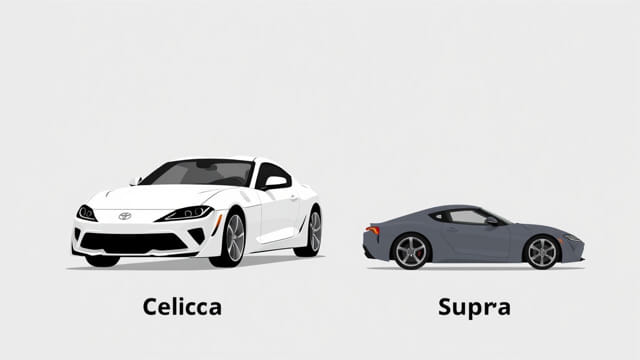
When discussing Japanese sports cars, two names often come up with enthusiastic reverence: the Toyota Celica and the Toyota Supra. These vehicles, while separate models, share a unique historical relationship that sometimes leads to confusion about their identity. For car enthusiasts or curious buyers wondering, Is a Celica a Supra? the answer is rooted in decades of Toyota’s automotive evolution. To fully understand this relationship, it’s important to explore the origins, development, and eventual divergence of these two iconic cars.
The Historical Connection Between Celica and Supra
Origins of the Celica
The Toyota Celica debuted in 1970 as a compact, stylish, and affordable coupe aimed at younger drivers. It was Toyota’s answer to the growing demand for sporty yet practical vehicles. The Celica became known for its sleek design and reliable engineering, offering a range of four-cylinder engines over its production lifespan. It was a front-engine, rear-wheel-drive car until the mid-1980s, after which it transitioned to front-wheel drive.
The Birth of the Supra as a Celica Variant
The Supra actually began its life as a variant of the Celica. In 1978, Toyota introduced the Celica Supra (also known as the Celica XX in Japan), which featured a longer wheelbase and a more powerful inline-six engine. This vehicle retained much of the Celica’s styling and platform but aimed for a higher-performance niche. The Celica Supra was designed to compete with sports cars like the Datsun Z-series while providing comfort and practicality.
Shared Platform in Early Years
From 1978 to 1986, the Supra was indeed part of the Celica family. It shared the same chassis, interior elements, and body structure but had significant upgrades under the hood and in suspension tuning. During these years, it was accurate to say that a Supra was a Celica, at least in the sense that it was derived from the same base model.
The Separation of Celica and Supra
The 1986 Split
In 1986, Toyota decided to separate the Celica and the Supra into two distinct models. The Celica continued on its path as a front-wheel-drive sports coupe, focusing more on economy and style. Meanwhile, the Supra became a standalone rear-wheel-drive performance car with a focus on speed, handling, and technological advancement.
Distinct Identities
After the split, the Celica and Supra followed different engineering philosophies. The Celica targeted buyers who wanted an affordable, sporty car, and many models were equipped with smaller engines and front-wheel drive. The Supra, on the other hand, evolved into a high-performance machine, culminating in the fourth-generation Supra (A80), which featured the legendary 2JZ-GTE twin-turbo engine and became an icon of 1990s performance.
Comparing Celica and Supra Models
Performance and Engine Options
- Celica: Typically came with 4-cylinder engines, with variants like the Celica GT-S and All-Trac Turbo offering modest performance upgrades.
- Supra: Offered powerful inline-six engines, both naturally aspirated and turbocharged, particularly in the Mk3 and Mk4 generations.
Drivetrain Differences
- Celica: Transitioned to front-wheel drive in 1986, with some models like the All-Trac retaining all-wheel drive.
- Supra: Remained rear-wheel drive throughout its run, emphasizing handling and balance.
Design Philosophy
The Celica emphasized lightweight design and sharp styling, making it a favorite for tuners and rally fans. The Supra was built for grand touring and speed, with a heavier body and more refined suspension systems suited for highway cruising and track performance alike.
Are They the Same Today?
Modern Interpretations
Today, the Toyota Supra exists as a revived nameplate launched in 2019 through a collaboration with BMW. It shares a platform and powertrain with the BMW Z4 but carries the Supra name and spirit. The Celica, on the other hand, has not been produced since 2006. The modern Supra is not based on the Celica in any way, which means the two are now entirely unrelated.
Legacy Models and Enthusiast Value
Both vehicles have maintained strong legacies in car culture. The Celica, especially the rally-inspired GT-Four variants, enjoys a cult following. The Supra, particularly the Mk4, has become a legend in tuning communities and motorsport thanks to its power potential and pop culture appearances.
Key Takeaways
So, is a Celica a Supra?
- Yes, historically: From 1978 to 1986, the Supra was part of the Celica family and shared a platform and design.
- No, after 1986: The Supra became its own model, distinct from the Celica in nearly every way engine, drivetrain, design, and performance.
Which One is Better?
The answer depends on what you’re looking for. The Celica is lighter, more affordable, and has a rally racing heritage. It’s great for those who want a nimble, stylish car. The Supra, however, is more powerful and performance-oriented, ideal for speed lovers and collectors. Both cars have their own fan bases and merits.
While it’s understandable why people might confuse the Celica and the Supra due to their shared beginnings, they are not the same car especially in modern terms. The Supra may have started as a Celica variant, but it evolved into something far more powerful and performance-driven. On the other hand, the Celica continued its journey as a more accessible, sportier option for everyday drivers. Both models have helped shape Toyota’s reputation in motorsports and the global auto market. If you’re asking whether a Celica is a Supra, the most accurate answer is: it was, once but now, it stands apart as its own distinct piece of automotive history.