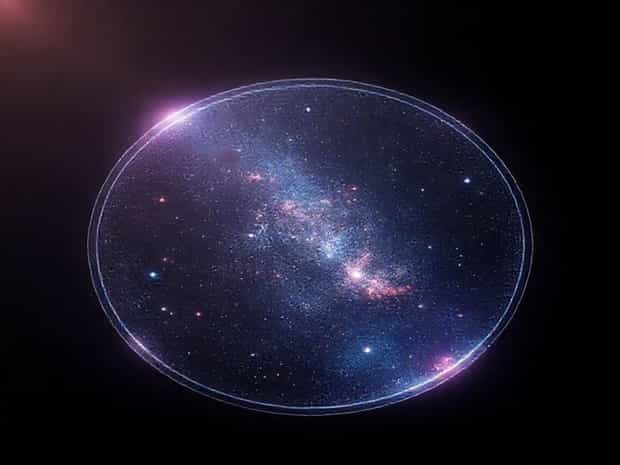
The concept of a holographic universe challenges our fundamental understanding of reality, suggesting that all the information contained within the cosmos might be encoded on a distant, two-dimensional surface. This idea, derived from theoretical physics and quantum mechanics, has captivated scientists and philosophers alike, as it proposes that the three-dimensional world we perceive may be an emergent illusion from a deeper, underlying structure. Exploring whether the universe is holographic requires an examination of modern physics theories, observational evidence, and the implications for our perception of space, time, and matter.
The Holographic Principle
The holographic principle is a concept rooted in theoretical physics, primarily influenced by studies of black holes and string theory. It posits that all of the information contained within a volume of space can be represented by information encoded on the boundary of that space, similar to how a hologram encodes a three-dimensional image on a two-dimensional surface. The principle arose from efforts to resolve the paradoxes associated with black holes, particularly the black hole information paradox, which questions how information about matter entering a black hole can be preserved without violating the laws of quantum mechanics.
Origins in Black Hole Physics
In the 1970s, physicists like Jacob Bekenstein and Stephen Hawking discovered that black holes have entropy proportional to the surface area of their event horizon, not their volume. This observation suggested that the information content of a black hole could be encoded on its surface rather than within its interior, leading to the revolutionary idea that the universe itself might operate under similar principles. Leonard Susskind and Gerard ‘t Hooft later generalized this notion, proposing that the universe might fundamentally be holographic, with a two-dimensional encoding underlying the three-dimensional phenomena we observe.
Evidence Supporting a Holographic Universe
While the holographic universe remains a theoretical concept, several lines of research hint at its plausibility. These include studies of cosmic microwave background radiation, quantum entanglement, and the behavior of black holes.
Cosmic Microwave Background (CMB)
The CMB is the residual radiation from the Big Bang, and its minute temperature fluctuations provide a map of the early universe. Some researchers have suggested that subtle patterns in these fluctuations could be consistent with a holographic model, implying that the information encoding the universe might be present on a two-dimensional surface. While not conclusive, such studies indicate that observable phenomena could be manifestations of deeper holographic principles.
Quantum Entanglement and Information Theory
Quantum mechanics introduces concepts such as entanglement, where ptopics separated by vast distances appear to influence each other instantaneously. This phenomenon challenges classical notions of space and locality and supports the idea that information in the universe may not be confined to the three-dimensional space we perceive. The holographic principle provides a framework to understand how information could be distributed and preserved in ways that transcend conventional dimensions.
Implications for Physics and Cosmology
If the universe is indeed holographic, it has profound implications for our understanding of space, time, and the fundamental nature of reality. Here are several areas impacted by this concept
- Gravity and General RelativityA holographic universe may provide a path to reconcile general relativity with quantum mechanics, offering insights into the quantum nature of gravity.
- Black Hole Information ParadoxIt could explain how information is preserved in black holes, resolving longstanding debates about information loss in extreme environments.
- Cosmology and Universe StructureHolographic principles might shed light on the large-scale structure of the cosmos, dark energy, and the expansion of space.
- Perception of RealityIf three-dimensional experiences are projections of a deeper two-dimensional reality, it challenges philosophical and existential notions of space, matter, and consciousness.
Challenges and Skepticism
Despite its fascinating implications, the holographic universe hypothesis faces significant challenges. Direct experimental evidence is limited, and much of the theory remains mathematical and abstract. Critics argue that current observations could be explained by conventional physics without invoking holographic principles. Furthermore, translating a two-dimensional encoding into our perceived three-dimensional reality is a complex theoretical problem that has yet to be fully resolved. As a result, the idea remains a bold and speculative frontier in physics.
Experimental Efforts
Scientists are exploring ways to test the holographic hypothesis. Some experiments aim to detect holographic noise, which would manifest as subtle, random fluctuations in space-time due to the encoding of information on a two-dimensional surface. Advanced detectors, such as interferometers, are being used to search for these minute signals. Although no definitive evidence has been found so far, these efforts represent an important step in moving the holographic principle from theoretical speculation to empirical science.
Theoretical Developments
Theoretical physics continues to develop models that incorporate holographic principles. String theory, for instance, provides a framework where the universe can be described in terms of lower-dimensional boundaries. AdS/CFT correspondence, a concept in string theory, demonstrates a concrete mathematical example of a holographic relationship, where a gravity theory in a higher-dimensional space corresponds to a quantum field theory on a lower-dimensional boundary. Such models strengthen the plausibility of a holographic universe and guide future research directions.
Philosophical and Conceptual Implications
Beyond physics, the holographic universe concept invites profound philosophical questions. If our perceived reality is a projection of underlying information, then notions of space, time, and matter may be emergent rather than fundamental. This perspective challenges classical intuitions and encourages reevaluation of human perception and consciousness. It also raises questions about the limits of scientific knowledge and whether ultimate reality can ever be fully comprehended.
Public Interest and Popular Culture
The idea that the universe could be holographic has captured the imagination of both scientists and the general public. Popular science books, documentaries, and media frequently explore the concept, framing it as a mysterious and mind-bending possibility. While popular interpretations often simplify the mathematics, they highlight the profound implications for how humans understand existence and the cosmos.
The question of whether the universe is holographic remains one of the most intriguing in modern science. Rooted in theoretical physics, black hole studies, and quantum mechanics, the holographic principle challenges conventional notions of space, time, and reality. While direct evidence is still limited, ongoing research in cosmology, quantum information, and theoretical physics continues to explore this possibility. If confirmed, a holographic universe would revolutionize our understanding of the cosmos, bridging the gap between general relativity and quantum mechanics and redefining our perception of existence itself. Until then, the concept remains a profound hypothesis at the intersection of physics, philosophy, and human curiosity, urging us to reconsider the very nature of reality.