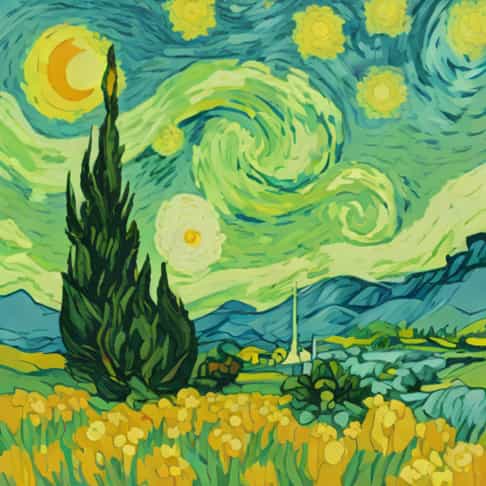
Many people who admire Vincent van Gogh eventually wonder whether he should be considered an Impressionist or an Expressionist. The question arises because his paintings share qualities with both movements the bright colors of Impressionism and the emotional intensity typical of Expressionism. Van Gogh’s unique style does not always fit neatly into a single category, which often leaves art lovers confused about where he truly belongs. Understanding his influences, technique, and artistic evolution can help clarify how he fits into the history of art and why the debate continues.
Van Gogh’s Connection to Impressionism
Exposure to the Impressionist Movement
When Vincent van Gogh moved to Paris in 1886, he encountered the Impressionist painters whose ideas transformed the way he approached art. Artists like Claude Monet, Edgar Degas, and Pierre-Auguste Renoir emphasized capturing light, atmosphere, and everyday moments. Their loose brushwork and bright color palettes differed greatly from the darker tones Van Gogh used earlier in his career.
Living in Paris exposed him to new techniques and materials. He began using lighter pigments, experimenting with broken color effects, and painting en plein air-outdoors, like many Impressionists did. These explorations helped him step away from the traditional academic style and toward a more modern, expressive approach.
Impressionist Techniques in His Work
Some characteristics of Impressionism appear clearly in Van Gogh’s paintings. These include
- Visible, quick brushstrokes that capture movement and light
- A brighter, more colorful palette than his early works
- A focus on contemporary life, such as cafés, gardens, and landscapes
- An interest in how natural light changes the appearance of objects
Paintings like The Café Terrace at Night and La Cour de l’Auberge Ravoux show how he incorporated these Impressionist ideas. Yet, even when he adopted their techniques, his style often carried more intensity and personal emotion than that of typical Impressionists.
Van Gogh and the Rise of Expressionism
Emotional Depth and Personal Vision
While Impressionists aimed to capture fleeting moments of light and color, Expressionism focuses on conveying powerful internal feelings. Van Gogh’s work is known for its emotional impact-something closer to Expressionism than to Impressionism. His paintings often transformed real scenes into vibrant, swirling visions meant to reflect his inner world rather than simply depict the external one.
The thick impasto brushstrokes, dramatic contrasts, and energized movement seen in works like Starry Night reveal a deeper emotional and psychological dimension. This quality made Van Gogh a major influence on 20th-century Expressionist painters, even though he himself lived before Expressionism became a formal movement.
Expressionist Qualities in His Art
Several features of Van Gogh’s paintings fit the Expressionist style
- Intense emotional expression through color and form
- Bold, exaggerated brushstrokes that convey personal feeling
- Compositions that prioritize mood over realistic representation
- Symbolic or psychological use of color, such as blue for melancholy or yellow for hope
These qualities show why many art historians describe him as a precursor to Expressionism rather than a pure Impressionist.
Why Van Gogh Is Best Described as Post-Impressionist
Going Beyond the Limits of Impressionism
Although Van Gogh borrowed ideas from the Impressionists, he wanted painting to express more than momentary impressions. He believed art should reflect emotional truth, spiritual depth, and symbolic meaning. This desire pushed him into a different direction-one that formed the foundation of Post-Impressionism.
Post-Impressionist artists, including Paul Gauguin, Georges Seurat, and Paul Cézanne, sought to expand or reject Impressionist ideas. They experimented with color theory, structure, and expressive techniques. Van Gogh fit naturally within this group because his work combined observational painting with intense inner emotion.
What Makes Post-Impressionism the Best Fit
Van Gogh is widely classified as a Post-Impressionist because
- He built on Impressionist ideas but pushed them further.
- His art contained emotional and symbolic meaning not typical of Impressionism.
- He developed a distinctive style that heavily influenced later modern art movements.
- His use of color and brushstroke went beyond representation and toward expression.
Post-Impressionism serves as a bridge between the earlier Impressionist movement and later forms like Fauvism and Expressionism. Van Gogh stands at the center of that evolution.
Key Examples Showing His Artistic Blend
Paintings with Impressionist Influence
Some works highlight Van Gogh’s Impressionist side
- Fishing Boats on the Beach at Saintes-Maries – captures natural light and seascape atmosphere.
- The Seine with the Pont de la Grande Jatte – shows loose brushwork and bright outdoor colors.
- Boulevard de Clichy – resembles Parisian Impressionist scenes of daily life.
These works demonstrate how he absorbed Impressionist methods during his time in Paris.
Paintings Pointing Toward Expressionism
Other masterpieces show why he is often linked to Expressionism
- Starry Night – swirling skies and emotional intensity reflect inner turmoil.
- Wheatfield with Crows – dark skies and dynamic movement evoke psychological tension.
- The Night Café – bold color contrasts express mood rather than realism.
These paintings reveal the expressive side of his artistic vision, making him a vital inspiration for Expressionist painters of the 20th century.
Why the Debate Continues Among Art Lovers
People continue to ask whether Van Gogh is an Impressionist or Expressionist because his style blends qualities of both movements. He used Impressionist techniques like visible brushstrokes and vibrant colors, yet he infused these methods with intense emotional energy. His work does not sit neatly within one category, which is why discussions about his artistic identity continue today.
Additionally, many who admire his paintings are introduced to him outside of strict art-historical classifications. For general audiences, the emotional power of his art makes him seem like an Expressionist, while the bright colors and brushwork resemble Impressionism. Because of this, misunderstanding is natural, and exploring the differences helps viewers better appreciate his work.
So, is Van Gogh Impressionist or Expressionist? The most accurate answer is that he is neither in the strictest sense-Van Gogh is a Post-Impressionist. He drew inspiration from Impressionism but used color and emotion in ways that anticipated Expressionism. His style stands at a crossroads in art history, combining bright light and vibrant color with deep emotional resonance. This unique blend is what makes his work unforgettable and why he continues to be one of the most influential artists of all time.