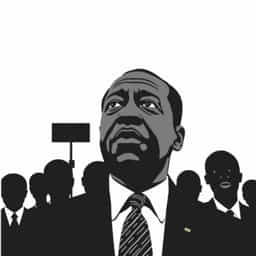
John Lewis, a key figure in the American civil rights movement, dedicated his life to the pursuit of justice, equality, and human rights. From his early days as a student activist to his long tenure in the U.S. Congress, Lewis became a symbol of nonviolent resistance and moral courage. His involvement in pivotal events such as the Freedom Rides, the March on Washington, and the Selma to Montgomery marches cemented his legacy as a leader who never hesitated to get into what he famously called good trouble. His unwavering commitment to civil rights helped to transform the United States and continues to inspire new generations of activists.
Early Life and Awakening to Injustice
Growing Up in the Segregated South
John Robert Lewis was born on February 21, 1940, near Troy, Alabama, into a family of sharecroppers. As a young boy, he witnessed firsthand the harsh realities of segregation and racial inequality. Schools, public facilities, transportation, and even water fountains were divided by race. Despite this environment, Lewis developed a strong sense of justice and a deep connection to his Christian faith, which would later influence his commitment to nonviolence.
Inspired by Martin Luther King Jr.
Lewis’s passion for change was ignited when he heard Martin Luther King Jr. on the radio in 1955. King’s words inspired him to pursue a path of peaceful protest and civic engagement. After enrolling at Fisk University in Nashville, Tennessee, Lewis became active in the civil rights movement and began attending nonviolent protest workshops led by James Lawson. These early experiences shaped his philosophy and leadership style.
Student Activism and the Freedom Rides
Founding Member of SNCC
In 1960, John Lewis became one of the original 13 Freedom Riders who challenged segregation on interstate buses throughout the South. Their mission was dangerous and met with violence, but Lewis remained committed to nonviolence. The Freedom Rides played a critical role in pressuring the federal government to enforce Supreme Court rulings that banned segregated buses and terminals.
Later that year, Lewis helped form the Student Nonviolent Coordinating Committee (SNCC), one of the most important grassroots organizations of the civil rights era. SNCC empowered young people and students to engage in direct action and voter registration efforts. Lewis eventually became chairman of SNCC in 1963, making him one of the youngest leaders of the movement at just 23 years old.
The March on Washington and Big Six Leadership
A Voice of Youth and Determination
In August 1963, John Lewis stood alongside Martin Luther King Jr., A. Philip Randolph, and other prominent civil rights leaders at the March on Washington for Jobs and Freedom. As one of the Big Six, he was the youngest speaker at the event. His speech was fiery and urgent, calling out the federal government for its inaction and demanding justice for Black Americans.
Though his original speech was toned down at the last minute due to concerns about its confrontational tone, Lewis’s voice rang clear with passion. He expressed the frustrations of a generation and reinforced the demand for voting rights, economic opportunity, and equal protection under the law.
Selma and the Struggle for Voting Rights
Bloody Sunday and National Attention
Perhaps the most iconic moment of John Lewis’s civil rights journey came on March 7, 1965, during the Selma to Montgomery march. Lewis and fellow activist Hosea Williams led over 600 marchers across the Edmund Pettus Bridge in Selma, Alabama. They were met by a brutal attack from state troopers wielding clubs and tear gas. Lewis suffered a skull fracture in the assault, an image that shocked the nation.
The violence of ‘Bloody Sunday’ was broadcast on television, sparking national outrage and galvanizing support for civil rights legislation. The event is widely credited with influencing the passage of the Voting Rights Act of 1965, which outlawed discriminatory voting practices such as literacy tests and poll taxes.
Legacy in Congress and Continued Advocacy
Champion for Justice in the House of Representatives
In 1986, John Lewis was elected to the U.S. House of Representatives for Georgia’s 5th congressional district. He served in Congress for over three decades, earning a reputation as the Conscience of the Congress. Lewis advocated for a wide range of issues, including health care, education, and immigration, but civil rights remained his central focus.
He was instrumental in renewing and strengthening the Voting Rights Act and repeatedly called attention to issues of police brutality, racial injustice, and voter suppression. Lewis also opposed wars he believed were unjust and remained deeply committed to nonviolence and the principles of peaceful resistance.
Modern Movements and Good Trouble
Even late in his life, John Lewis continued to engage in activism. He marched with students, participated in sit-ins, and spoke out against injustice wherever it occurred. In 2016, he led a sit-in on the House floor demanding gun control legislation. His legacy inspired the Black Lives Matter movement and countless other campaigns for equity and reform.
Honors, Tributes, and Enduring Influence
A Life of Recognition and Respect
Throughout his life, John Lewis received numerous awards and honors, including the Presidential Medal of Freedom in 2011, bestowed by President Barack Obama. Statues, bridges, schools, and streets have been named in his honor. His memoir, Walking with the Wind, and graphic novel series March continue to educate and inspire readers around the world.
- Presidential Medal of Freedom– Awarded in 2011
- March graphic novel trilogy– Co-authored with Andrew Aydin
- John Lewis Voting Rights Advancement Act– Proposed legislation to restore voting protections
Legacy Beyond Words
John Lewis passed away on July 17, 2020, but his influence endures. His life’s work stands as a testament to the power of moral clarity, perseverance, and peaceful protest. He reminded Americans that democracy requires vigilance and participation, and that each citizen has a role in shaping a more just and equitable society.
The Heart of the Civil Rights Movement
John Lewis was more than a civil rights leader he was a moral compass for a nation struggling to live up to its ideals. Through decades of service, both in the streets and in the halls of Congress, he challenged injustice and called upon every generation to stand up and speak out. His legacy is not only etched in history books but lives on in the ongoing fight for racial and social equality. As he often said, Never, ever be afraid to make some noise and get in good trouble, necessary trouble.