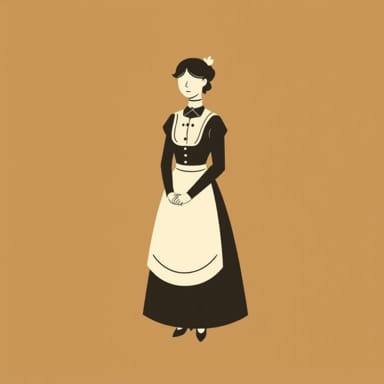
The diaries of Hannah Cullwick offer a rare and compelling glimpse into the life of a Victorian maidservant. Unlike most working-class women of the 19th century, whose voices have been lost to history, Cullwick left behind a detailed record of her thoughts, labor, and personal struggles. Her journals are not only informative accounts of domestic service but also reflections on class, gender, and identity in Victorian England. Through her words, we gain valuable insight into how a maidservant navigated the rigid boundaries of a deeply hierarchical society.
Who Was Hannah Cullwick?
Hannah Cullwick was born in 1833 in Shropshire, England, into a working-class family. From an early age, she entered service as a domestic worker. Over her lifetime, she worked in various roles, including scullery maid, housemaid, and cook. What made Cullwick’s story extraordinary was not her profession, but her secret relationship with her employer, Arthur Munby a barrister and writer obsessed with working-class women. The two maintained a complicated, long-term relationship that defied Victorian norms.
The Content of Her Diaries
The diaries of Hannah Cullwick span several decades and include a mix of daily entries, personal reflections, and letters. They document everything from her work routine to her emotions, relationships, and inner conflicts.
Life in Domestic Service
Cullwick wrote in detail about the tasks she performed each day, offering modern readers a vivid picture of Victorian domestic labor. Her entries described:
- Washing laundry by hand
- Scrubbing floors and grates
- Preparing food from scratch
- Cleaning and polishing boots and silverware
These chores were physically demanding, and Cullwick’s writing emphasizes the long hours and repetitive nature of her duties. She took pride in her strength and endurance, which she saw as a mark of a true servant.
Class Identity and Power Dynamics
One of the most fascinating aspects of Cullwick’s diaries is her awareness of class distinctions. She did not simply accept her position as a maidservant she embraced it, sometimes even exaggerated it. This was especially evident in her relationship with Arthur Munby. In their private lives, Cullwick often performed the role of a slave-like servant, wearing chains or blackening her face with soot to emphasize her lowly status.
This dynamic was partly theatrical but also psychological. Cullwick seemed to find a sense of identity and control in her submission. Her diaries suggest that she saw herself as morally superior to upper-class women, whom she viewed as weak and untested by labor. The diaries blur the lines between social reality and performance, making them unique among Victorian personal writings.
The Secret Relationship with Arthur Munby
Cullwick’s relationship with Arthur Munby was central to her life and writings. Though they kept it secret for years, they eventually married in 1873, though Cullwick insisted on continuing to live as a servant. Munby encouraged her to write and even took photographs of her in various servant poses. Their relationship was unconventional and complex, mixing affection, class fetishism, and power imbalances.
The Role of Performance and Disguise
Hannah Cullwick often used disguises to move between social roles. She could dress as a middle-class woman when traveling with Munby, but she felt more at ease in her maidservant clothes. This ability to shift appearances is a recurring theme in her diaries. It reveals how identity in Victorian England could be shaped not just by birth but by behavior, dress, and perception.
The Language and Style of the Diaries
Cullwick wrote in plain English, with simple vocabulary and inconsistent spelling. This unpolished style gives her diaries an authenticity often missing from edited memoirs. Her entries are honest and sometimes raw, conveying her frustrations, pride, and inner turmoil. The lack of literary flair does not detract from the power of her words in fact, it enhances them.
Emotional Honesty and Inner Conflict
Throughout her writings, Cullwick expressed deep loyalty to Munby, along with moments of doubt and guilt. She struggled with religious beliefs and often wondered whether her lifestyle was proper. These internal battles made her writing more than a record of events they became a mirror of a woman trying to reconcile love, duty, and self-worth in a world that offered her few choices.
Importance for Historians and Scholars
The diaries of Hannah Cullwick are now regarded as valuable historical documents. They provide firsthand evidence of working-class life, female labor, and the private thoughts of someone rarely represented in traditional histories. Scholars in gender studies, labor history, and Victorian culture have all drawn on her writings to explore how power and identity functioned in the 19th century.
A Rare Voice from Below
Most Victorian-era diaries that have survived were written by the middle or upper classes. Cullwick’s account is rare because it comes from a woman of the servant class. Her voice adds depth and complexity to our understanding of Victorian society, challenging the idea that only the wealthy left behind meaningful records.
Legacy of Hannah Cullwick
Today, Hannah Cullwick’s diaries continue to resonate. They raise timeless questions about identity, labor, love, and autonomy. Her life story complicates our view of Victorian values and opens a window into the private world of a woman who refused to be forgotten. Despite the strict confines of class and gender, she carved out a form of self-expression that still speaks across the years.
For readers today, her diaries offer more than just a glimpse into the past. They remind us that even the most ordinary lives are worthy of record, and that the experiences of those in the margins often hold the richest insights into human nature.
1/2