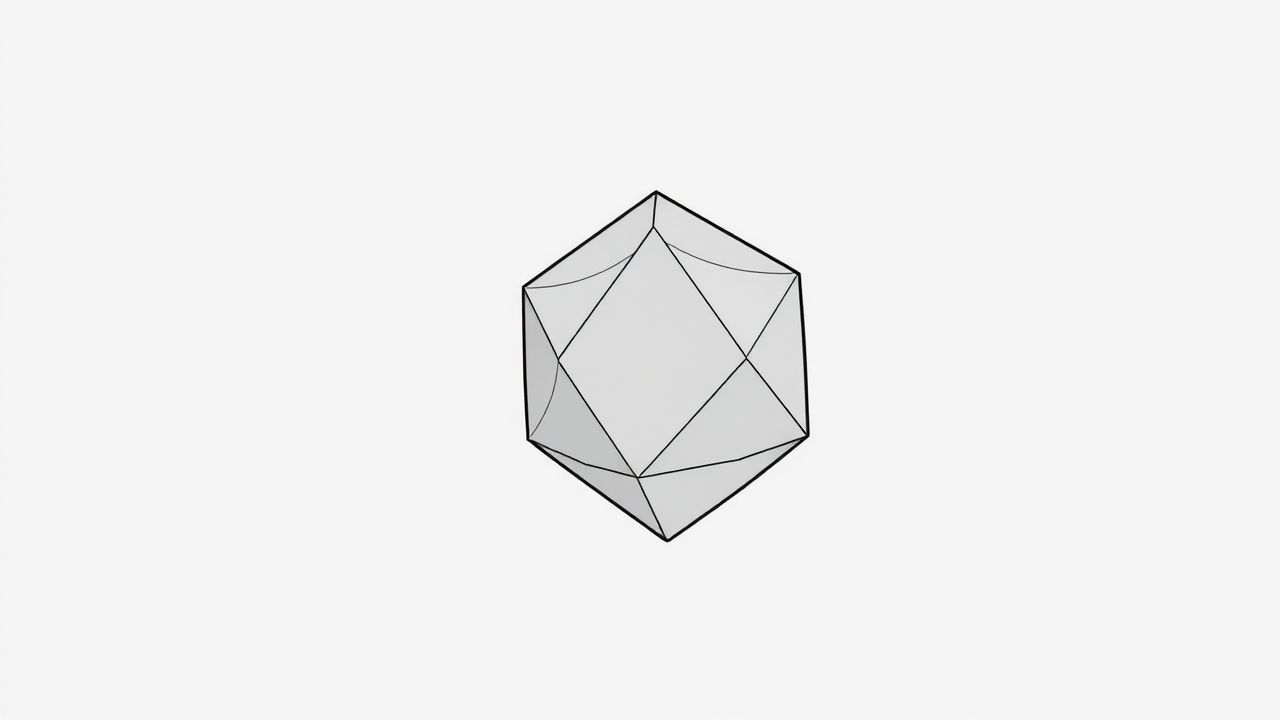
When we talk about three-dimensional shapes, one of the most interesting and fundamental concepts is the idea of a polyhedron. A polyhedron is a solid figure with flat polygonal faces, straight edges, and sharp vertices. These faces are not just decorative surfaces; they are the building blocks that give a polyhedron its shape, symmetry, and structure. Understanding the faces of a polyhedron, how they are formed, and how they relate to other elements of the shape is an important part of geometry. From simple cubes to complex dodecahedrons, faces define the outer boundary of the solid and help determine its mathematical properties.
Definition of a Face in a Polyhedron
The faces of a polyhedron are the flat surfaces that enclose the shape. Each face is a polygon, meaning it is a flat shape with straight sides. The size, shape, and number of faces depend on the type of polyhedron. For example, a cube has six square faces, while a triangular prism has five faces two triangular and three rectangular.
Relationship Between Faces, Edges, and Vertices
Faces are closely related to edges and vertices. An edge is the line segment where two faces meet, and a vertex is the point where edges intersect. The relationship between the number of faces (F), vertices (V), and edges (E) in a convex polyhedron is described by Euler’s formula
V – E + F = 2
This formula applies to many well-known polyhedra and shows the mathematical connection between their components.
Examples of Faces in Common Polyhedra
Cube
A cube has 6 faces, all of which are congruent squares. Every angle is a right angle, and every edge is the same length.
Triangular Prism
This polyhedron has 5 faces 2 triangular faces and 3 rectangular faces. The two triangular faces are parallel and congruent.
Pyramid
A square pyramid has 5 faces 1 square base and 4 triangular faces that meet at the apex. The triangular faces are often isosceles triangles.
Dodecahedron
A regular dodecahedron has 12 faces, each of which is a regular pentagon. It is one of the five Platonic solids.
Types of Faces in Polyhedra
- Regular FacesAll faces are congruent regular polygons, such as in Platonic solids.
- Irregular FacesThe faces are polygons that may differ in size and shape.
- Mixed FacesSome polyhedra have different types of polygons as faces, such as prisms and pyramids.
Platonic Solids and Their Faces
Platonic solids are a special group of polyhedra with identical regular polygonal faces. There are exactly five Platonic solids
- Tetrahedron – 4 triangular faces
- Cube (or Hexahedron) – 6 square faces
- Octahedron – 8 triangular faces
- Dodecahedron – 12 pentagonal faces
- Icosahedron – 20 triangular faces
In each case, every face is the same size and shape, and the arrangement of faces around each vertex is identical.
How to Count Faces in a Polyhedron
To count faces, you should look at each distinct flat surface and ensure you do not count the same face twice. A systematic way is to start from one side and move around the shape, marking each face mentally or on a diagram. For complex polyhedra, drawing them in a net form (a two-dimensional layout of all faces) can make counting easier.
The Role of Faces in Geometry
Faces are not just about appearance; they play a key role in calculating surface area, understanding symmetry, and solving spatial problems. In many cases, the type of polygon that forms the face influences the formulas used to find measurements such as area and volume. Faces also affect how light reflects off a polyhedron, which is important in design, architecture, and 3D modeling.
Real-Life Examples of Polyhedron Faces
Architecture
Buildings and structures often use polyhedron-like shapes. The glass panels of a geodesic dome act as the faces of a large, complex polyhedron.
Games and Dice
Dice come in various polyhedron forms, such as cubes, octahedrons, and icosahedrons. The faces determine the possible outcomes of a roll.
Crystals
Many natural crystals have flat faces that form naturally due to molecular structure, resembling polyhedra.
Surface Area and Faces
To find the surface area of a polyhedron, you calculate the area of each face and then sum them up. For a cube, since all faces are equal squares, you can multiply the area of one face by six. For irregular polyhedra, each face might need to be measured separately before adding them together.
Faces in Irregular Polyhedra
Not all polyhedra have symmetrical or identical faces. In irregular polyhedra, faces can be different polygons, and angles between them may vary. These shapes are common in architecture, design, and nature, offering more creative and functional possibilities than strictly regular shapes.
Importance in Mathematical Modeling
In computational geometry and computer graphics, faces are essential for defining the surface of 3D objects. They are often stored as data in the form of vertices and edges, which are then connected to form polygons. This is the basis of 3D modeling in video games, simulations, and virtual reality environments.
Visualizing Faces Through Nets
A net is a two-dimensional pattern that can be folded into a three-dimensional polyhedron. Each polygon in the net represents one face of the polyhedron. Studying nets helps in visualizing the structure and number of faces before constructing the shape.
Euler’s Formula and Faces
Using Euler’s formula, you can determine the number of faces if you know the vertices and edges. For example, if a polyhedron has 8 vertices and 12 edges, we can use V – E + F = 2
8 – 12 + F = 2 → F = 6, meaning it has six faces, just like a cube.
The faces of a polyhedron are more than just the outer shell of a 3D shape; they are fundamental elements that determine the structure, symmetry, and physical properties of the solid. Whether they are all identical, like in a cube, or varied and irregular, like in many architectural designs, faces define the polyhedron’s identity. Understanding them helps in geometry, design, and practical applications across many fields. By exploring the faces, we gain insight into the balance between mathematics and the physical world, where shapes define both function and beauty.