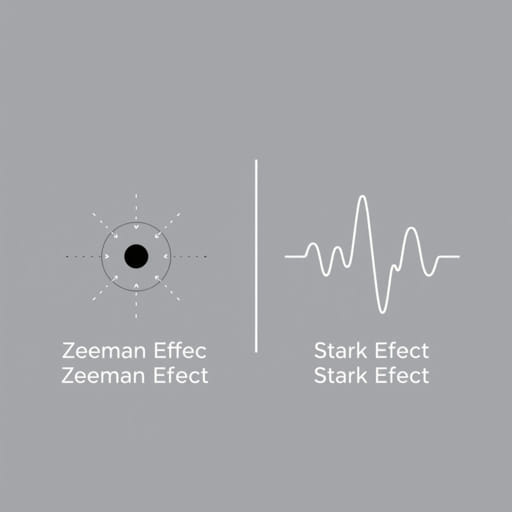
The study of atomic spectra has played a fundamental role in understanding the behavior of atoms and the nature of light. Among the most important phenomena in spectroscopy are the Zeeman effect and the Stark effect, which reveal how external fields influence the energy levels of atoms. These effects provide valuable insights into atomic structure, electron interactions, and the fundamental principles of quantum mechanics. By observing the splitting of spectral lines under the influence of magnetic and electric fields, scientists have been able to confirm theoretical predictions and develop advanced applications in physics, chemistry, and astronomy. Understanding these phenomena is essential for both students and researchers interested in the interaction between light and matter.
What is the Zeeman Effect?
The Zeeman effect refers to the splitting of atomic energy levels when an atom is placed in a magnetic field. This effect was first discovered by the Dutch physicist Pieter Zeeman in 1896, who observed that spectral lines emitted by certain elements would split into multiple components in the presence of a magnetic field. The phenomenon occurs because the magnetic field interacts with the magnetic moments of electrons, which are associated with both their orbital and spin angular momenta. As a result, the degeneracy of energy levels is lifted, leading to distinct spectral lines that can be measured and analyzed.
Mechanism of the Zeeman Effect
In the presence of a magnetic field, the Hamiltonian of an atom includes an additional term that accounts for the interaction between the magnetic field and the magnetic moment of electrons. This interaction causes energy levels that were previously degenerate (having the same energy) to split according to the orientation of the electron’s angular momentum with respect to the field. The magnitude of the splitting is proportional to the strength of the magnetic field and the magnetic quantum number of the electrons. In general
- Normal Zeeman EffectOccurs when the spin of electrons does not contribute, typically resulting in a triplet splitting of spectral lines.
- Anomalous Zeeman EffectOccurs when both orbital and spin contributions are significant, leading to more complex splitting patterns.
Applications of the Zeeman Effect
The Zeeman effect has several important applications in science and technology
- AstrophysicsMeasurement of magnetic fields in stars and other celestial bodies through spectral line splitting.
- Atomic PhysicsDetermination of electron configurations and verification of quantum mechanical models of atoms.
- Laser TechnologyControl of laser emission lines in devices like Zeeman lasers and magneto-optical traps.
- Magnetic Field MeasurementHighly sensitive magnetometers, such as the Zeeman effect-based atomic magnetometer, rely on this phenomenon.
What is the Stark Effect?
The Stark effect, named after German physicist Johannes Stark who discovered it in 1913, is the splitting or shifting of atomic energy levels in the presence of an external electric field. Unlike the Zeeman effect, which involves magnetic interactions, the Stark effect results from the influence of electric fields on the distribution of electrons around the nucleus. This effect demonstrates how an atom’s energy levels are sensitive not only to magnetic fields but also to electric forces, offering another window into the fundamental interactions that govern atomic behavior.
Mechanism of the Stark Effect
The Stark effect arises because the external electric field perturbs the potential experienced by electrons within an atom. The Hamiltonian of the system gains an additional term proportional to the product of the electric field and the position of the electron. This perturbation leads to shifts or splittings in the energy levels depending on the field strength and the orientation of the electron cloud. The Stark effect can be categorized as
- Linear Stark EffectEnergy shifts are directly proportional to the electric field strength, often observed in atoms with degenerate states such as hydrogen.
- Quadratic Stark EffectEnergy shifts are proportional to the square of the electric field, more common in non-degenerate states or complex atoms.
Applications of the Stark Effect
The Stark effect is widely used in various scientific and industrial fields
- SpectroscopyHigh-resolution analysis of atomic and molecular spectra, useful for identifying chemical compositions.
- Laser TuningAdjusting the frequency of lasers by applying electric fields to active media in devices like tunable lasers.
- Quantum OpticsManipulating quantum states in experiments involving cold atoms, ions, and Rydberg states.
- Electric Field MeasurementDetermining local electric field strengths in plasmas, gases, or other environments using Stark spectroscopy.
Comparing the Zeeman and Stark Effects
Both the Zeeman and Stark effects involve the splitting of atomic energy levels, but they differ in the type of external field and the mechanisms involved. Key differences include
- Field TypeZeeman effect is caused by magnetic fields, while Stark effect is caused by electric fields.
- InteractionZeeman effect involves magnetic moments and angular momentum, whereas the Stark effect involves electric dipole moments and electron cloud distributions.
- ApplicationsZeeman effect is heavily used in astrophysics and magnetic field measurement, while Stark effect finds wide applications in spectroscopy and laser tuning.
- Line Splitting PatternsZeeman effect can produce triplets or complex multi-line patterns, whereas Stark effect typically causes linear or quadratic shifts depending on atomic degeneracy.
Importance in Quantum Mechanics
Both effects provide experimental verification of quantum mechanical principles, including the quantization of angular momentum and energy levels. Observing how spectral lines split in response to magnetic or electric fields allows scientists to test theoretical predictions and refine models of atomic structure. The Zeeman and Stark effects also demonstrate the sensitivity of atoms to external perturbations, offering insights into fundamental symmetries and interactions within atoms. These phenomena have become essential teaching examples in quantum mechanics courses, illustrating the connection between theory and observable physical effects.
Modern Research and Technology
In contemporary research, the Zeeman and Stark effects are utilized in cutting-edge technologies such as atomic clocks, quantum computing, and precision spectroscopy. For example
- Atomic clocks exploit Zeeman splitting to achieve extremely accurate time measurements by stabilizing transition frequencies.
- Quantum information experiments use Stark tuning to manipulate qubits encoded in atomic or molecular states.
- High-resolution telescopes detect Zeeman splitting in stellar spectra to study magnetic fields across galaxies, advancing our understanding of astrophysical processes.
- Laser development and frequency stabilization frequently rely on both Zeeman and Stark effects to control emission properties with high precision.
The Zeeman effect and Stark effect are cornerstone phenomena in atomic physics, illustrating the profound influence of external magnetic and electric fields on atomic energy levels. By observing the splitting or shifting of spectral lines, scientists have been able to validate quantum mechanics, explore atomic structure, and develop advanced technologies. While the Zeeman effect highlights the role of magnetic interactions and angular momentum, the Stark effect emphasizes the impact of electric fields and electron distribution. Both effects continue to play crucial roles in research, technology, and education, offering powerful tools for spectroscopy, laser development, quantum optics, and astrophysical studies. Understanding these effects not only deepens our knowledge of the microscopic world but also provides practical applications that impact science and industry today.