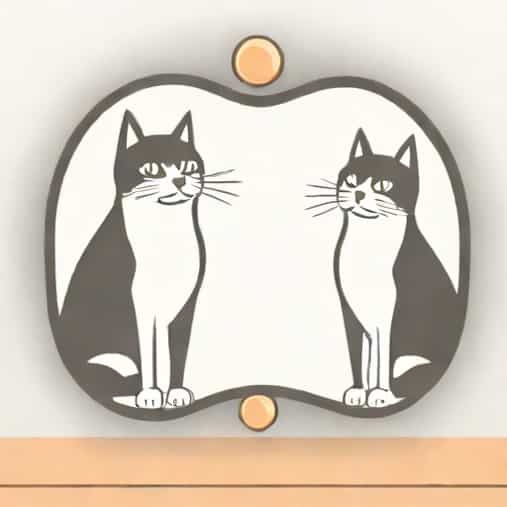
Cats are fascinating creatures with complex behaviors and intelligence that often puzzle their human companions. One question that has intrigued pet owners and scientists alike is whether cats recognize themselves in a mirror. Observing a cat interacting with its reflection can be amusing, confusing, and even mysterious. Understanding how cats perceive mirrors, their cognitive abilities, and the differences between self-recognition in humans and other animals provides insight into feline psychology and sensory perception.
Mirror self-recognition and its significance
Mirror self-recognition (MSR) is a psychological concept used to determine whether an animal can identify itself in a reflective surface. In humans, MSR usually develops in toddlers around 18 to 24 months. Researchers often use the mark test, which involves placing a non-toxic mark on an animal in a location they can only see in a mirror. If the animal investigates or attempts to remove the mark, it is considered evidence of self-recognition. This test has been applied to various animals, including primates, dolphins, elephants, and birds, but its results for cats are less clear.
The biology behind feline perception
Cats perceive the world primarily through their senses of smell, hearing, and vision. Unlike humans, who rely heavily on visual cues, cats use olfactory and tactile information to understand their surroundings. This sensory difference affects how cats interact with mirrors. While they can see the reflection, the absence of corresponding smells or tactile feedback may prevent them from fully recognizing the image as themselves. This reliance on multiple senses explains why cats often react to mirrors in ways that seem curious or playful rather than reflective.
Typical cat behaviors in front of mirrors
When cats encounter mirrors, their reactions can vary widely. Observing these behaviors helps researchers understand their cognitive processing and emotional responses. Some common behaviors include
- CuriosityCats may approach the mirror cautiously, sniff the edges, or paw at the surface to investigate.
- PlayfulnessSome cats treat their reflection as another cat, engaging in playful gestures like swatting or pouncing.
- AggressionCertain cats may hiss, arch their backs, or exhibit defensive behaviors if they perceive the reflection as a rival intruder.
- IndifferenceExperienced cats may eventually ignore the mirror, suggesting they do not associate it with another animal or themselves.
Why cats often do not recognize themselves
Cats’ lack of mirror self-recognition may stem from several factors. First, their primary sense is smell, and a reflection provides no olfactory cues. Second, cats are solitary hunters by nature, so social comparison and mirror awareness may be less relevant than for social animals like primates. Third, the visual information in a mirror does not align with their natural experience of movement and interaction, making it unlikely that a cat interprets the image as itself. Instead, the reflection may simply be an intriguing visual stimulus or a perceived companion.
Scientific studies on cats and mirrors
Research on cats’ mirror behavior is limited but offers valuable insights. Studies indicate that cats generally do not pass the mirror mark test, which suggests they do not recognize themselves in the same way that humans or some primates do. Instead, cats often respond to mirrors with exploratory or investigative behaviors, indicating curiosity rather than self-awareness. Some experiments have shown that cats quickly habituate to mirrors, losing interest after repeated exposure, which supports the idea that they do not perceive the reflection as a distinct individual or themselves.
Comparisons with other animals
While cats may not recognize themselves in mirrors, other animals demonstrate varying degrees of self-awareness. For example
- Great apes, such as chimpanzees and orangutans, often pass the mirror mark test.
- Dolphins and elephants exhibit behaviors consistent with self-recognition.
- Certain bird species, like magpies, can identify marks on their bodies using mirrors.
These comparisons highlight the diversity of cognitive abilities across species and suggest that self-recognition is closely tied to social structure, sensory reliance, and evolutionary pressures. Cats’ solitary and scent-oriented lifestyle may explain why mirrors hold limited meaning for them.
Practical implications for cat owners
Understanding that cats do not typically recognize themselves in mirrors has practical benefits for pet owners. It explains why cats may react with curiosity or playfulness but do not show signs of identity awareness. Mirrors can be used to provide enrichment, such as visual stimulation or interactive play, without causing distress. However, it is important to monitor individual cats for stress or aggressive reactions, especially if the reflection provokes fear or territorial behavior.
Enrichment and safe interaction
Pet owners can use mirrors as part of a cat’s environment to stimulate mental and physical activity. Strategies include
- Allowing supervised play near mirrors to encourage exploration.
- Introducing reflective toys or surfaces to create novel visual experiences.
- Using mirrors cautiously to avoid triggering fear or aggression in sensitive cats.
While mirrors do not provide true self-recognition for cats, they can contribute to a stimulating and engaging environment that promotes overall well-being.
Do cats recognize themselves in mirrors? Current research and observation suggest that they do not. Cats rely primarily on smell and other senses rather than visual self-awareness, which makes mirrors a limited tool for identity recognition. Instead, cats interact with mirrors out of curiosity, playfulness, or perceived social interaction. While cats may not pass the mirror mark test, understanding their behavior in front of reflective surfaces sheds light on feline cognition, sensory priorities, and emotional responses. For cat owners, mirrors offer a safe and enriching form of stimulation, highlighting the fascinating ways that cats perceive and interact with the world around them.