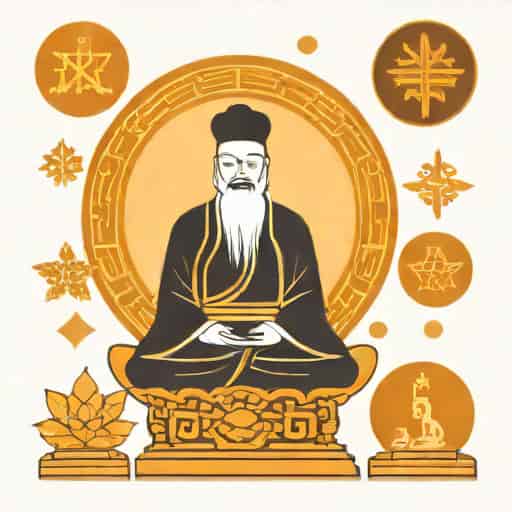
Confucianism is one of the most influential philosophical and ethical systems in human history, originating in ancient China and continuing to shape East Asian societies today. One of the most common questions about Confucianism is whether it is monotheistic, polytheistic, or something else entirely. Unlike religions that center on the worship of a single god or multiple deities, Confucianism primarily focuses on moral philosophy, social harmony, and the cultivation of virtue. This raises important questions about its spiritual framework and how adherents relate to concepts of divinity, the supernatural, and the cosmic order. Understanding whether Confucianism can be classified as monotheistic or polytheistic requires an exploration of its texts, rituals, and historical development, as well as its broader cultural context.
The Origins of Confucian Thought
Confucianism was founded by Confucius, also known as Kong Fuzi, who lived from 551 to 479 BCE in what is now modern-day China. His teachings were recorded by disciples in texts such as the Analects, and later developed further in works like the Book of Rites and the Doctrine of the Mean. Confucius emphasized ethical conduct, filial piety, respect for elders, proper governance, and the cultivation of personal virtue. Central to Confucian thought is the idea of ren, which translates roughly to humaneness or benevolence. The system is more concerned with moral obligations and societal harmony than with worshiping specific deities.
Concept of Heaven (Tian)
In Confucianism, the concept of Tian, often translated as Heaven, plays a central role. However, Tian is not a god in the traditional monotheistic sense. Rather, Tian represents a cosmic moral order, a source of moral authority, and a guiding principle for human behavior. Confucius viewed Heaven as impersonal, functioning more like a natural law or ethical framework than a deity with personal desires. While rituals and sacrifices to Heaven were part of traditional practices, these were aimed at maintaining harmony and showing respect rather than appeasing a god in a monotheistic sense.
Polytheistic Elements in Confucian Practice
Despite its ethical focus, Confucianism does incorporate practices that resemble polytheism, especially in historical and cultural contexts. In traditional Chinese society, Confucian rituals often involved veneration of ancestors, local spirits, and a pantheon of cultural deities. These practices coexist with Confucian moral teachings and are not necessarily contradictory. Ancestor worship, for example, is central to Confucian ritual life, reflecting respect for family lineage and societal continuity. While these elements might seem polytheistic, they are largely symbolic and ethical in nature, emphasizing moral lessons and social cohesion rather than devotion to multiple gods.
Ancestor Worship and Rituals
Ancestor worship is a key practice within Confucian communities and illustrates how Confucianism blends philosophical and spiritual elements. Families perform rituals at home or in temples, offering food, incense, and prayers to honor deceased relatives. This practice reflects the Confucian value of filial piety, or xiao, and underscores the importance of family, continuity, and respect for past generations. While these rituals involve spiritual beings, the emphasis remains on moral and social duty rather than theological doctrine, which differentiates Confucian ancestor worship from polytheistic religion in a strict sense.
Confucianism and the Question of Monotheism
Classifying Confucianism as monotheistic is challenging. Unlike monotheistic religions such as Christianity, Islam, or Judaism, Confucianism does not center on worship of a singular, omnipotent deity. Tian may be invoked as a moral authority, but it lacks the personal attributes and relational aspects typical of monotheistic gods. The focus of Confucianism is largely on human ethics, governance, and societal well-being. Therefore, although Tian could be seen as a unifying cosmic principle, Confucianism does not promote monotheism in the conventional sense.
Ethical Monism and Moral Authority
Some scholars describe Confucianism as ethically monistic because of its emphasis on a single overarching moral order, represented by Heaven. Ethical monism differs from theological monotheism in that it prioritizes principles over the personhood of a deity. Confucius taught that adherence to Heaven’s moral order leads to harmony, both individually and socially. In this view, Confucianism emphasizes alignment with universal principles rather than the worship of a singular god, highlighting its unique position in the spectrum of spiritual and philosophical traditions.
Comparative Perspectives
When compared with other world religions, Confucianism occupies a unique space. It is neither fully monotheistic nor fully polytheistic, and it is sometimes categorized as a philosophical or ethical system rather than a religion in the conventional sense. While ritual practices and cosmological concepts exist, the primary concern is human conduct and societal order. This has led some scholars to refer to Confucianism as a religion without gods or a secular religion, emphasizing moral and civic responsibilities rather than theological beliefs.
Integration with Other Belief Systems
Throughout history, Confucianism has often coexisted with Taoism, Buddhism, and folk religion in East Asia. This syncretism allowed Confucian ethical principles to guide social and political life while other traditions addressed questions of spirituality, afterlife, and divine beings. The coexistence of multiple spiritual frameworks demonstrates that Confucianism’s ethical core is adaptable and not inherently tied to strict monotheism or polytheism. Instead, it serves as a guiding philosophy for ethical living, social harmony, and moral cultivation.
Modern Interpretations
In contemporary society, Confucianism continues to influence social norms, education, and political thought, particularly in China, Korea, and Vietnam. Modern interpretations often emphasize Confucian ethical teachings without requiring ritual adherence or supernatural belief. This focus on ethics and moral reasoning aligns with Confucius’ original vision of creating a harmonious society through virtuous behavior. While some modern practitioners may incorporate rituals or ancestral respect, the system remains fundamentally non-theistic, centering on human development and social ethics rather than divine worship.
Summary and Conclusion
Confucianism cannot be easily classified as monotheistic or polytheistic. Its focus is primarily on ethics, social harmony, and moral cultivation rather than the worship of gods. Concepts like Tian provide a framework for understanding moral order, while ancestor veneration and rituals incorporate symbolic spiritual elements without constituting strict polytheism. In essence, Confucianism is best understood as a philosophical and ethical system that occasionally integrates spiritual practices, emphasizing duty, virtue, and human relationships. By blending cosmological concepts, ritual observances, and moral philosophy, Confucianism occupies a unique position in the spectrum of human belief systems, demonstrating that the pursuit of ethical living can transcend conventional categories of monotheism and polytheism.