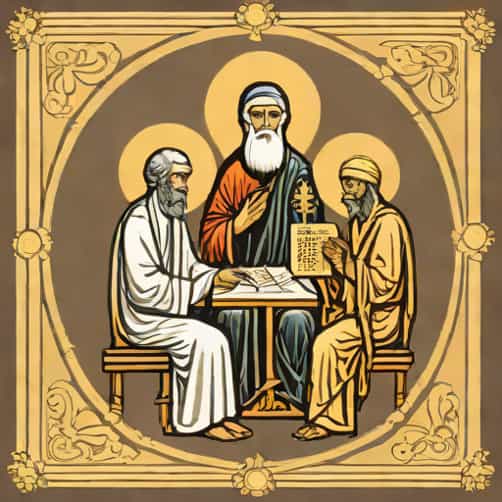
The Epistle of Cyril to Nestorius stands as one of the most defining documents in early Christian theology, representing a crucial turning point in the Christological controversies of the fifth century. This letter was not merely a personal correspondence between two bishops; it was a powerful theological manifesto that defended the unity of Christ’s divine and human natures. Written by Saint Cyril of Alexandria to Nestorius, the Patriarch of Constantinople, the epistle sought to correct what Cyril saw as a dangerous theological error that threatened the very foundation of Christian belief in the Incarnation.
Historical Background
To understand the importance of the Epistle of Cyril to Nestorius, it is necessary to consider the historical and theological context of the early fifth century. At that time, the Church was struggling to define the nature of Christ. The Council of Nicaea in 325 AD had already affirmed that Christ was fully divine, of one substance with the Father. However, the precise relationship between Christ’s divinity and humanity remained a subject of deep debate.
Nestorius, who became Patriarch of Constantinople around 428 AD, began to preach that the Virgin Mary should not be calledTheotokos(meaning God-bearer) but ratherChristotokos(Christ-bearer). He argued that Mary gave birth to the human Jesus, not the divine Word itself. This teaching implied a separation between the divine and human persons of Christ, which alarmed many theologians. Cyril of Alexandria, one of the most prominent church fathers of the time, perceived Nestorius’s view as a denial of the true Incarnation.
Cyril’s Response to Nestorius
Cyril’s epistle was a response to the growing controversy. He believed Nestorius’s teachings endangered the doctrine of salvation. For Cyril, if Christ were divided into two separate persons-one human and one divine-then the unity of the Savior would be destroyed. Salvation depended on the fact that the Word of God truly became man, taking on human nature without ceasing to be divine.
In his letter, Cyril emphasized that the Word and the flesh were united in one and the same person. He wrote that it was not a mere man who suffered and died for humanity, but God the Word who, in his human nature, experienced suffering. Therefore, the titleTheotokoswas appropriate because Mary gave birth to the one who is both fully God and fully man.
Theological Significance of the Letter
The Epistle of Cyril to Nestorius is filled with theological depth. Cyril used language that would later influence the Council of Ephesus in 431 AD. He described the Incarnation not as a mingling or confusion of natures but as a true union in one person. He rejected any idea that divided Christ into two separate beings or suggested that the divine and human operated independently within him.
One of the key theological points Cyril made was the concept of the hypostatic union, meaning the union of the divine and human natures in the one person of Christ. This term later became central to orthodox Christology. Cyril insisted that the Word did not merely dwell in a human being as in a temple but became flesh-an essential unity without confusion.
Main Themes of the Epistle
- Unity of ChristThe letter emphasizes that Jesus Christ is one person, both fully divine and fully human. There is no division between the two natures.
- TheotokosCyril defends the title of Mary as Mother of God to affirm that the one she bore was God incarnate, not a mere human vessel.
- Salvific PurposeThe unity of Christ’s person is directly tied to the salvation of humanity. Only if the divine Word truly became man could humanity be redeemed.
- Opposition to NestorianismThe letter refutes the idea that Christ was composed of two persons, one divine and one human, working separately.
Council of Ephesus and Its Outcome
The Epistle of Cyril to Nestorius was presented at the Council of Ephesus in 431 AD, a gathering called by Emperor Theodosius II to resolve the growing conflict. Cyril’s letter became a central document in the proceedings. The Council ultimately sided with Cyril, declaring Nestorius’s teachings heretical and affirming Mary’s title asTheotokos. This marked a defining moment in Church history, shaping the future of Christian doctrine.
At the Council, the bishops recognized Cyril’s epistle as an authoritative statement of orthodox faith. They concluded that anyone who divided Christ into two persons could not be considered a true Christian teacher. The condemnation of Nestorius led to his exile, and the unity of Christ’s person was affirmed as a foundational doctrine of Christianity.
Structure and Tone of the Epistle
Cyril’s epistle is both pastoral and polemical. While it maintains a tone of respect toward Nestorius, it does not compromise on theological truth. Cyril writes as a bishop deeply concerned for the faith of the Church and the salvation of believers. He appeals to Scripture, the writings of early Church Fathers, and the Nicene Creed to support his arguments.
The letter also reflects Cyril’s role as a leader who sought unity within the Church. His goal was not to create division but to protect the faithful from what he viewed as a dangerous misunderstanding of Christ’s nature. Despite its theological complexity, the epistle’s purpose was simple to affirm that the Word truly became flesh and that the one born of Mary was none other than God himself in human form.
Lasting Impact on Christian Doctrine
The influence of the Epistle of Cyril to Nestorius extended far beyond the fifth century. It became a cornerstone of orthodox Christology and was later reaffirmed at the Council of Chalcedon in 451 AD. The Chalcedonian Definition, which described Christ as one person in two natures, without confusion, change, division, or separation, drew heavily on the ideas first articulated by Cyril.
Throughout history, theologians from both Eastern and Western traditions have regarded Cyril’s letter as a model of doctrinal precision. It bridged the gap between theological speculation and the lived faith of the Church, providing a clear articulation of how God and humanity were united in Christ for the sake of salvation.
Modern Relevance
Even today, the Epistle of Cyril to Nestorius remains a subject of study for theologians, historians, and believers. Its emphasis on the unity of Christ continues to shape discussions about Christology and ecumenical dialogue between different Christian denominations. The letter is also a reminder of how deeply theological debates were intertwined with political and ecclesiastical power during the early centuries of Christianity.
For modern readers, the epistle offers a window into the intellectual and spiritual struggles of the early Church. It reveals how carefully the early theologians sought to preserve the mystery of the Incarnation without falling into simplifications that would distort the truth of the Gospel. By defending the titleTheotokosand affirming the unity of Christ, Cyril’s epistle continues to echo through the centuries as a profound testimony to the faith of the Church.
The Epistle of Cyril to Nestorius is more than an ancient document-it is a declaration of faith that continues to define Christian orthodoxy. Through this letter, Cyril of Alexandria articulated one of the most essential truths of Christianity that the Word of God truly became man for the salvation of the world. The debates it inspired, and the clarity it achieved, helped shape the theological foundation of the universal Church. In defending the unity of Christ’s person, Cyril ensured that the mystery of the Incarnation would remain at the heart of Christian belief for generations to come.