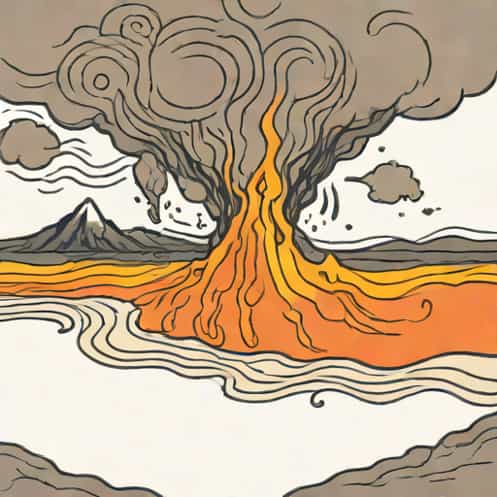
Fluid basaltic eruptions represent one of the most common and visually striking forms of volcanic activity on Earth. These eruptions are characterized by the outpouring of low-viscosity basaltic lava that can travel long distances from the vent, forming extensive lava flows, shields, and other volcanic features. Unlike more explosive eruptions associated with high-silica magmas, fluid basaltic eruptions tend to be effusive, producing rivers of molten rock rather than violent ash clouds. Understanding how fluid basaltic eruptions form is crucial for volcanologists, hazard assessment, and understanding planetary geology, as these eruptions shape landscapes and influence the environment over large areas.
Understanding Basaltic Magma
Basaltic magma is low in silica content, typically around 45-55%, which gives it a relatively low viscosity compared to rhyolitic or andesitic magmas. This low viscosity allows gases to escape more easily, reducing internal pressure and favoring effusive eruptions rather than explosive ones. Basaltic magma is rich in iron, magnesium, and calcium, which contributes to its dark coloration and fluid properties. The high temperature of basaltic magma, often exceeding 1,100°C, also plays a key role in its ability to flow rapidly across the landscape. These properties are central to understanding why fluid basaltic eruptions form and how they behave during an eruption.
Sources of Basaltic Magma
Basaltic magma originates primarily from the partial melting of the Earth’s upper mantle. Mantle plumes, mid-ocean ridges, and volcanic hotspots are common locations where basaltic magma forms. At mid-ocean ridges, decompression melting produces basaltic magma that erupts to create new oceanic crust. Hotspot volcanism, such as that seen in Hawaii, produces large volumes of basaltic lava that give rise to shield volcanoes. Subduction zones can also produce basaltic magma, although the composition may be slightly altered due to interactions with crustal material. In all cases, the fundamental properties of basaltic magma – low viscosity and high temperature – make it prone to forming fluid eruptions.
Mechanisms of Fluid Basaltic Eruptions
Fluid basaltic eruptions occur when magma rises through the Earth’s crust and reaches the surface. The process begins with magma generation in the mantle, followed by ascent due to buoyancy. As the magma rises, pressure decreases, allowing dissolved gases, primarily water vapor and carbon dioxide, to exsolve. Because basaltic magma is low in viscosity, these gases escape relatively easily, preventing the buildup of pressure that leads to explosive eruptions. Once the magma reaches the surface, it flows freely, producing lava flows that can extend for kilometers from the vent. The nature of these flows – whether they are smooth, ropy pahoehoe or jagged aÄ – depends on the temperature, gas content, and eruption rate of the lava.
Factors Controlling Eruption Style
- Magma CompositionLower silica content favors fluidity and effusive behavior.
- TemperatureHigher magma temperatures reduce viscosity and enhance flow.
- Gas ContentLimited gas accumulation prevents explosive activity and allows continuous lava effusion.
- Crustal PathwaysThe geometry and size of conduits influence the speed and volume of lava reaching the surface.
Formation of Lava Flows
Once basaltic magma erupts, it spreads outwards from the vent, forming lava flows that can cover vast areas. The initial flow often forms a thin, fast-moving layer of molten rock. As the surface cools, a solid crust forms while the underlying lava continues to flow, creating distinctive features. Pahoehoe flows are smooth and ropey, while aÄ flows are rough and blocky due to higher cooling rates and the breakup of the lava crust. Lava tubes can develop under the hardened surface, allowing magma to travel further distances without cooling, which contributes to the widespread distribution of basaltic lava fields.
Volcanic Structures Associated with Fluid Basaltic Eruptions
Fluid basaltic eruptions give rise to distinctive volcanic landforms. Shield volcanoes are the most prominent, characterized by broad, gently sloping profiles built up by successive lava flows. Other features include lava plateaus, flood basalts, and cinder cones. Flood basalt provinces, such as the Deccan Traps or Columbia River Basalts, are the result of massive basaltic eruptions over millions of years, covering large regions with thick basalt layers. These structures highlight the ability of fluid basaltic magma to reshape landscapes dramatically over time.
Examples of Fluid Basaltic Eruptions
- Hawaiian volcanoes, such as Mauna Loa and Kilauea, exhibit classic fluid basaltic eruptions with extensive lava flows and pahoehoe formations.
- Icelandic eruptions at volcanoes like Laki and Eldgjá demonstrate fissure-fed basaltic lava flows that can cover hundreds of square kilometers.
- Flood basalt events, including the Deccan Traps in India, represent large-scale eruptions that have had significant climatic and environmental impacts.
Hazards and Impacts
While fluid basaltic eruptions are generally less explosive than high-silica eruptions, they still pose significant hazards. Lava flows can destroy infrastructure, bury roads, and threaten communities in their path. Gas emissions, primarily carbon dioxide and sulfur dioxide, can affect air quality and contribute to acid rain. In some cases, interactions between lava and water or snow can cause steam explosions. Despite these hazards, fluid basaltic eruptions are often predictable in terms of flow paths, allowing for early warnings and evacuation planning, which mitigates risks to human life.
Environmental and Geological Implications
Fluid basaltic eruptions play an important role in shaping the Earth’s surface. The basaltic lava forms fertile soils over time, supports unique ecosystems, and creates new land, especially in volcanic island settings. Geologically, these eruptions provide insights into mantle processes, magma dynamics, and the thermal and chemical evolution of the Earth. Basaltic lava flows are also preserved in the rock record, allowing scientists to reconstruct past volcanic activity and understand long-term tectonic processes.
Fluid basaltic eruptions are a fundamental process in volcanology, illustrating how low-viscosity, high-temperature magma interacts with the Earth’s surface. Their formation is governed by magma composition, temperature, gas content, and crustal pathways, resulting in effusive eruptions that produce lava flows, shield volcanoes, and extensive basalt provinces. While they present hazards to communities, these eruptions also shape landscapes, create fertile soils, and provide valuable scientific information about mantle dynamics and volcanic processes. Studying fluid basaltic eruptions enhances our understanding of volcanic behavior and helps prepare for and mitigate the risks associated with these spectacular natural events.