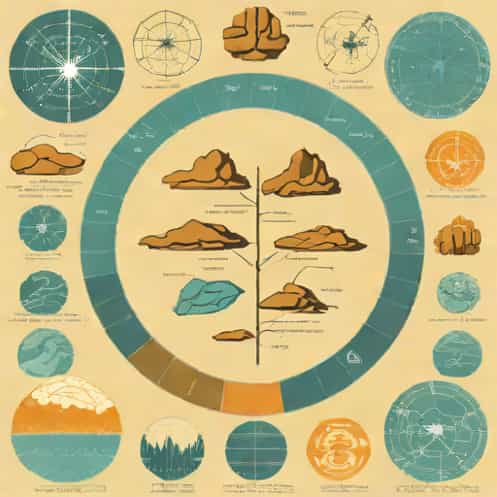
The Devonian period, often referred to as the Age of Fishes, represents a crucial chapter in the geological time scale, spanning roughly from 419 to 359 million years ago. This period is renowned for major evolutionary advancements and significant changes in Earth’s landscapes, climate, and ecosystems. During the Devonian, life underwent remarkable diversification both in the oceans and on land, setting the stage for future ecological systems. Fossil evidence from this era provides invaluable insight into the evolutionary history of fish, early terrestrial plants, and the first forests, highlighting the dynamic nature of Earth’s geological past.
Overview of the Geological Time Scale
The geological time scale is a system of chronological measurement used by geologists and paleontologists to describe the timing and relationships of events in Earth’s history. It is divided into eons, eras, periods, epochs, and ages. The Devonian belongs to the Paleozoic Era, which encompasses other significant periods such as the Cambrian, Ordovician, Silurian, and Carboniferous. Understanding the placement of the Devonian within this framework helps scientists contextualize the evolutionary and environmental changes that occurred during this time.
Subdivision of the Devonian Period
The Devonian period is further subdivided into three main epochs Early, Middle, and Late Devonian. Each epoch is characterized by distinctive geological and biological events.
- Early Devonian (Lochkovian to Emsian)This epoch witnessed the diversification of jawless and early jawed fishes and the initial colonization of terrestrial environments by plants and arthropods.
- Middle Devonian (Eifelian to Givetian)This era marked the rise of large reef systems and continued evolution of vascular plants, along with the appearance of the first forests.
- Late Devonian (Frasnian to Famennian)The Late Devonian was characterized by further diversification of fish, the spread of complex terrestrial ecosystems, and major extinction events that affected marine life.
Marine Life During the Devonian
The oceans of the Devonian period were vibrant and teeming with life. Fish experienced an evolutionary boom, earning the period its nickname. Jawed fishes, including early sharks and placoderms (armored fishes), became dominant predators in marine environments. Lobe-finned fishes and ray-finned fishes began diversifying, laying the foundation for later vertebrate evolution.
Coral reefs expanded dramatically during the Devonian, constructed primarily by stromatoporoids and tabulate corals. These reef systems created complex habitats that supported a variety of invertebrates such as brachiopods, trilobites, mollusks, and crinoids. The Devonian seas were hotspots of biodiversity, with intricate food webs and ecological interactions that resemble modern marine ecosystems in complexity.
Terrestrial Life and the First Forests
While marine life thrived, significant evolutionary events were occurring on land. Early vascular plants, such as rhyniophytes and lycophytes, spread across terrestrial landscapes, creating the first pioneering ecosystems. These plants contributed to soil formation, atmospheric oxygen levels, and the development of microhabitats for arthropods and other invertebrates.
The Middle Devonian saw the emergence of the first true forests, dominated by primitive trees like Archaeopteris. These forests transformed the Earth’s surface, stabilizing soil, altering hydrological cycles, and providing new ecological niches. Arthropods, including early insects and myriapods, adapted to terrestrial life, creating intricate food webs on land for the first time.
Significant Geological Events
The Devonian period was marked by dynamic geological processes that shaped continents and ocean basins. Tectonic activity led to the formation of mountain ranges and the assembly of supercontinents. Sedimentary deposits from this era, such as limestones, shales, and sandstones, preserve extensive fossil records that help scientists reconstruct ancient environments and ecological interactions.
Sea level changes during the Devonian influenced the development of shallow marine habitats and reef systems. Periods of marine transgression and regression contributed to the deposition of rich fossil-bearing strata. These changes also played a role in the Late Devonian extinction events, which affected reef-building organisms and marine biodiversity on a global scale.
Late Devonian Extinction
One of the most notable events of the Devonian period is the Late Devonian extinction, a series of crises that drastically impacted marine life. This extinction primarily affected reef-building organisms, placoderms, and other marine invertebrates. The causes of these extinctions are still debated but likely involved a combination of environmental stressors, including global cooling, changes in sea level, and widespread anoxia in oceans. These events paved the way for evolutionary shifts in the Carboniferous period, influencing which groups of organisms would dominate the subsequent eras.
Fossil Evidence and Scientific Importance
Fossils from the Devonian period are crucial for understanding the evolutionary history of life on Earth. Fish fossils reveal the progression from jawless to jawed vertebrates, while plant fossils demonstrate the transition from simple vascular plants to complex forest ecosystems. Fossilized reefs provide insights into ancient marine communities, biodiversity patterns, and the impact of environmental changes on ecosystems.
Notable fossil sites, such as the Devonian strata in North America and Europe, offer well-preserved specimens that inform paleontological research. These fossils allow scientists to study anatomical adaptations, ecological interactions, and evolutionary innovations that shaped the trajectory of life on Earth.
Impact on Modern Science
Studying the Devonian period within the geological time scale provides modern scientists with context for evolutionary biology, paleoclimatology, and Earth’s geologic history. Insights into how ecosystems respond to environmental stressors and extinction events can inform current studies on biodiversity loss and climate change. The Devonian serves as a model for understanding the complex interplay between life and environment over geological timescales.
The Devonian period represents a pivotal chapter in the geological time scale, characterized by the diversification of fish, the colonization of land by plants and arthropods, and the formation of the first forests. Its fossil record provides invaluable insight into evolutionary processes, ecological dynamics, and environmental change. By studying the Devonian, scientists gain a deeper understanding of how life on Earth has adapted and transformed over hundreds of millions of years, offering lessons that remain relevant in today’s study of biodiversity and climate. The Devonian continues to fascinate researchers, educators, and enthusiasts, standing as a testament to the enduring significance of Earth’s deep past.