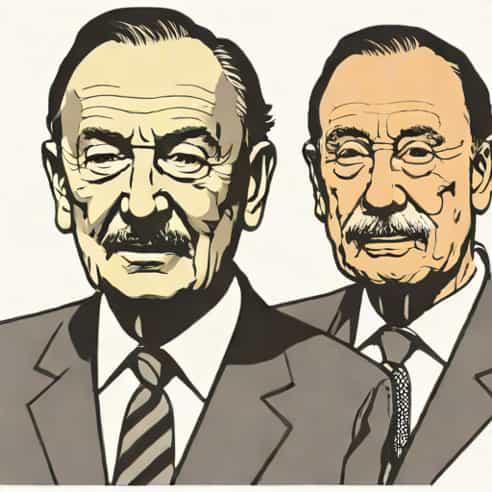
In British political discourse, the names Jeffrey Donaldson and Enoch Powell evoke two different yet interconnected eras of conservative and unionist thought. Both figures have played roles in shaping the political landscape of Northern Ireland and the United Kingdom, though separated by time and context. Donaldson, as a modern leader of the Democratic Unionist Party (DUP), has had to navigate the complexities of post-Brexit politics, while Powell, a Conservative MP known for his controversial Rivers of Blood speech, represented a more ideological and polarizing strain of mid-20th century conservatism. Understanding the connection between Jeffrey Donaldson and Enoch Powell helps illuminate how unionist identity and British conservatism have evolved through time.
Jeffrey Donaldson A Contemporary Unionist Leader
Jeffrey Donaldson was born in 1962 in Kilkeel, County Down, Northern Ireland. He entered politics at a young age, joining the Ulster Unionist Party (UUP) before eventually moving to the Democratic Unionist Party. Over the years, he became one of the most recognized voices in Northern Irish unionism. His leadership has been marked by efforts to defend Northern Ireland’s place within the United Kingdom, especially during the turbulent years following Brexit and the implementation of the Northern Ireland Protocol.
Donaldson’s political style combines pragmatism with a deep commitment to unionist principles. Unlike some of his predecessors, he tends to avoid inflammatory rhetoric, preferring to position himself as a stabilizing figure in a time of division. Yet, his political roots shaped by the complex legacy of The Troubles and the fragile peace established by the Good Friday Agreement reveal his alignment with a tradition of staunch unionist belief similar to that of older figures such as Enoch Powell.
Enoch Powell A Conservative Maverick
John Enoch Powell, born in 1912, was one of the most intellectually distinctive and controversial politicians in modern British history. Trained as a classicist and a soldier before entering politics, Powell quickly rose through the ranks of the Conservative Party in the 1950s and 60s. His eloquence and command of political theory earned him admiration among conservatives, but his legacy remains overshadowed by his infamous 1968 speech criticizing immigration and government policy, which became known as the Rivers of Blood speech.
Although Powell’s comments were widely condemned for their racial overtones, he retained a dedicated following among voters who believed he was articulating their frustrations with rapid social and demographic change. Beyond that controversy, Powell was also known for his strong advocacy of parliamentary sovereignty and his fierce opposition to the European Economic Community (EEC), which later evolved into the European Union. In this sense, his ideas foreshadowed much of the Euroscepticism that would later define British political debate and influence leaders like Jeffrey Donaldson.
Shared Themes Sovereignty, Identity, and the Union
While Jeffrey Donaldson and Enoch Powell came from different political environments Donaldson within the Northern Irish unionist sphere and Powell within British conservatism they shared key ideological foundations. Both men emphasized the importance of national sovereignty and the preservation of British identity. For Donaldson, this manifested in his defense of Northern Ireland’s constitutional status; for Powell, it was in his unwavering belief in the supremacy of the Westminster Parliament.
Powell’s influence in Northern Ireland politics was more direct than many realize. After leaving the Conservative Party, Powell joined the Ulster Unionist Party in 1974 and became the Member of Parliament for South Down. His decision to represent a Northern Irish constituency symbolized his deep commitment to the union between Great Britain and Northern Ireland. Powell saw the union as not merely a political arrangement but a cultural and historical bond that must be protected from both European integration and internal fragmentation.
Donaldson, decades later, found himself facing similar challenges this time in the context of the Brexit debate. The Northern Ireland Protocol created economic borders within the UK, something unionists like Donaldson saw as a betrayal of sovereignty and unity. In his speeches, he often echoed themes reminiscent of Powell’s rhetoric about the indivisibility of the nation and the dangers of external interference in British affairs.
Enoch Powell’s Time in Northern Ireland
Powell’s time representing South Down in the House of Commons (1974 1987) was an unusual chapter in British politics. He was one of the few English politicians to directly immerse himself in Northern Irish politics, advocating for the region’s integration into the rest of the United Kingdom. He rejected the idea of devolution and argued that Northern Ireland should be governed in the same way as any other British region.
Powell’s intellectual and ideological rigor appealed to some within the unionist community, but his uncompromising positions often isolated him from mainstream politics. Nonetheless, his ideas left a lasting imprint on Northern Ireland’s political culture, especially among those who viewed devolution and power-sharing with nationalists as threats to British sovereignty.
Jeffrey Donaldson and the Modern Unionist Dilemma
In contrast to Powell’s era, Jeffrey Donaldson’s leadership has been defined by negotiation and political compromise. He inherited a party navigating the aftermath of Brexit, where the DUP’s stance on sovereignty clashed with the realities of trade and governance. Donaldson has had to balance traditional unionist principles with the practical need to maintain political stability in Northern Ireland.
Unlike Powell, Donaldson operates within a framework where power-sharing with Irish nationalists is not only accepted but required by law. The Good Friday Agreement, signed in 1998, established a delicate balance between communities in Northern Ireland. While Donaldson has sometimes expressed frustration with aspects of this arrangement, he also recognizes its necessity in maintaining peace. This makes his brand of unionism more pragmatic, even if the ideological foundations remain similar to Powell’s.
Comparing Political Styles and Eras
The contrast between Powell’s oratory and Donaldson’s diplomacy highlights the evolution of unionist leadership. Enoch Powell was an intellectual provocateur brilliant, uncompromising, and often divisive. He saw politics as a battle of principles, where compromise was often equated with moral weakness. Donaldson, on the other hand, leads in an era that demands negotiation, consensus, and sensitivity to multiple identities within the United Kingdom.
Despite these differences, both figures share a certain conviction in the idea of British unity. Powell’s arguments against European integration and Donaldson’s opposition to the Northern Ireland Protocol both stem from a belief that sovereignty must remain undivided. Each, in his time, acted as a defender of what he saw as the core essence of the United Kingdom.
Influence and Legacy
Enoch Powell’s legacy remains deeply controversial. To some, he was a visionary who warned about the loss of sovereignty and the dangers of over-centralization. To others, he was a symbol of intolerance and division. Yet, regardless of opinion, his intellectual rigor and ability to challenge political orthodoxy made him one of the most influential figures in 20th-century British conservatism.
Jeffrey Donaldson’s legacy is still being written. His leadership of the DUP continues to shape the future of Northern Ireland’s politics, particularly in its relationship with London and Brussels. Like Powell, he faces the enduring question of what it means to preserve the union in an era of changing political and social realities. His ability to balance the ideological core of unionism with the demands of modern governance will determine how his leadership is remembered.
The connection between Jeffrey Donaldson and Enoch Powell lies in their shared defense of the United Kingdom’s unity and their deep belief in sovereignty. Powell’s time as an MP for South Down placed him directly within Northern Irish politics, influencing generations of unionists who came after him. Donaldson, though more cautious and conciliatory, continues to carry forward the torch of unionist ideals in a new and complex era.
Both men symbolize different moments in the ongoing story of British unionism Powell as the uncompromising ideologue, and Donaldson as the modern statesman navigating the delicate balance between principle and pragmatism. In understanding them together, we see how the politics of identity, sovereignty, and unity remain as vital and contested today as they were half a century ago.