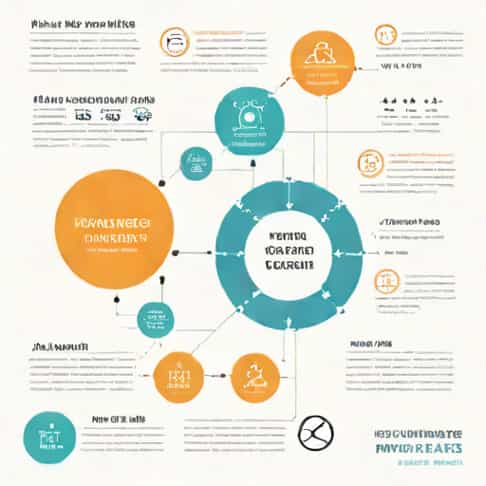
Knowledge graphs and text jointly embedding is an emerging approach in the field of artificial intelligence and natural language processing, combining the structured relationships of knowledge graphs with the unstructured information found in text. This method allows machines to better understand complex data by leveraging both semantic relationships and contextual information. By embedding knowledge graphs and text together, researchers can create richer representations of entities, relationships, and textual content, improving tasks such as question answering, information retrieval, recommendation systems, and knowledge discovery. The integration of these two data sources helps bridge the gap between symbolic reasoning and deep learning approaches, providing a more comprehensive understanding of data in AI applications.
Understanding Knowledge Graphs
Knowledge graphs are structured representations of information, consisting of entities and the relationships between them. They are typically represented as graphs where nodes represent entities, such as people, places, or concepts, and edges represent relationships, such as works at or located in. Knowledge graphs are widely used in search engines, recommendation systems, and AI applications to provide context-aware and semantically rich information. They allow machines to reason about entities and their interactions, making it possible to infer new facts or answer complex queries.
Key Components of Knowledge Graphs
- Entities The primary objects or nodes in the graph, representing concepts, objects, or people.
- Relations The edges connecting entities, representing semantic relationships such as is a type of or is located in.
- Attributes Properties or features of entities, providing additional information like age, category, or description.
- Ontology The schema or structure that defines the types of entities and relations, ensuring consistency and semantic understanding.
Text Embeddings
Text embeddings are numerical representations of words, phrases, or documents, capturing semantic meaning in a continuous vector space. Techniques such as Word2Vec, GloVe, BERT, and Transformer-based models have revolutionized natural language processing by allowing machines to understand context, similarity, and relationships in text. Text embeddings are used for tasks like sentiment analysis, document classification, and semantic search, providing a way to encode textual information into a format that can be processed by machine learning algorithms.
Importance of Text Embeddings
- Semantic Understanding Captures the meaning and context of words and phrases.
- Dimensionality Reduction Transforms high-dimensional textual data into compact numerical vectors.
- Similarity Measurement Enables computation of similarity between words, sentences, or documents.
- Facilitates Machine Learning Allows integration with deep learning models for various NLP tasks.
Joint Embedding of Knowledge Graphs and Text
Joint embedding of knowledge graphs and text refers to the process of learning a unified representation that combines structured knowledge with unstructured textual information. This approach enables AI models to capture both relational knowledge from graphs and contextual information from text, creating more robust representations for downstream tasks. For example, an entity in a knowledge graph such as Albert Einstein can be represented not only through its relationships like physicist or born in Germany, but also through textual descriptions from biographies, research papers, or news topics.
Benefits of Joint Embedding
- Enhanced Semantic Representation Combines relational and contextual knowledge for richer embeddings.
- Improved Question Answering Allows models to reason over structured facts and unstructured text simultaneously.
- Better Entity Linking Helps match textual mentions to entities in a knowledge graph accurately.
- Knowledge Completion Facilitates the discovery of missing relationships in the graph by leveraging textual evidence.
- Cross-modal Retrieval Supports searching text using knowledge graph queries and vice versa.
Techniques for Joint Embedding
Several methods have been developed to jointly embed knowledge graphs and text. One common approach is to learn separate embeddings for graph entities and text, then align them in a shared vector space using neural networks. Another method integrates textual features directly into the graph embedding process, enhancing the relational representation with semantic context. Transformer-based models and graph neural networks (GNNs) have been widely applied to this task, allowing complex interactions between entities, relationships, and textual information to be modeled effectively.
Popular Approaches
- TransE and its Variants Embed graph entities and relations, extended with textual information for joint learning.
- Graph Neural Networks (GNNs) Incorporate structural knowledge from graphs while integrating textual features.
- Transformer Models Use attention mechanisms to combine textual embeddings with entity embeddings from knowledge graphs.
- Knowledge-Text Alignment Models Align text and graph representations in a shared space for improved downstream tasks.
Applications of Knowledge Graph and Text Joint Embedding
The joint embedding of knowledge graphs and text has a wide range of applications across AI and data-driven industries. In search engines, it improves the understanding of queries by combining factual knowledge and semantic context. Recommendation systems benefit from enhanced user and item representations derived from both structured data and user-generated text. In healthcare, joint embeddings can link medical knowledge graphs with research papers and clinical notes, aiding in diagnosis and treatment suggestions. Additionally, joint embeddings enhance natural language understanding tasks, such as question answering, entity recognition, and knowledge discovery.
Examples of Applications
- Semantic Search Combines graph knowledge and textual context to deliver more accurate search results.
- Question Answering Systems Uses joint embeddings to answer complex queries with information from both graphs and text.
- Recommendation Systems Improves recommendations by integrating knowledge graphs of products or users with textual reviews.
- Biomedical Research Links entities in medical knowledge graphs with research literature for drug discovery or treatment suggestions.
- Knowledge Completion Predicts missing links or relationships in a graph using textual evidence.
Challenges and Future Directions
Despite the advantages, joint embedding of knowledge graphs and text faces several challenges. Aligning structured and unstructured data requires careful modeling, as the two types of information have different characteristics. Scalability is another concern, particularly for large knowledge graphs with millions of entities and vast textual corpora. Ensuring interpretability of joint embeddings is also important, as complex models may produce accurate results but lack transparency. Future research is likely to focus on improving scalability, enhancing interpretability, and developing models that can dynamically integrate knowledge from both sources in real-time applications.
Potential Research Directions
- Scalable algorithms for large-scale joint embeddings.
- Integration with multimodal data, including images and audio.
- Improved interpretability and explainability of embeddings.
- Dynamic updating of embeddings as knowledge graphs and textual data evolve.
- Applications in AI-driven decision support systems and real-time analytics.
Knowledge graph and text jointly embedding is a powerful approach that combines the strengths of structured and unstructured data to create enriched representations. By leveraging both relational knowledge from graphs and semantic context from text, this technique improves performance in various AI tasks such as question answering, recommendation systems, knowledge discovery, and semantic search. Although challenges remain, ongoing research in neural networks, graph embedding, and natural language processing continues to enhance the effectiveness and scalability of joint embeddings. As AI applications expand, the integration of knowledge graphs and text will play a critical role in enabling machines to understand and reason with information more effectively, bridging the gap between symbolic reasoning and contextual understanding.