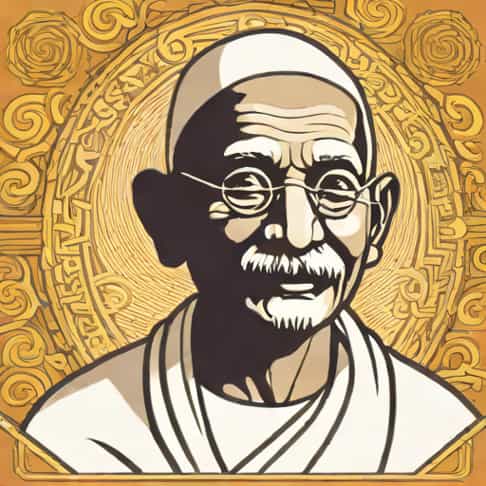
Mahatma Gandhi, often regarded as the father of the Indian nation, played a pivotal role in shaping the nationalist movement in India. His philosophy of nonviolence and civil disobedience transformed the struggle for independence into a moral and political campaign that inspired millions. Gandhi’s leadership was not only political but also deeply ethical, emphasizing the importance of truth, justice, and self-reliance. The nationalist movement in India, which sought to end British colonial rule, gained unprecedented momentum under his guidance, uniting people from diverse regions, religions, and social classes. Understanding Gandhi’s contribution to the nationalist movement reveals the power of peaceful resistance and the enduring impact of ethical leadership in history.
Early Life and Influences
Mahatma Gandhi was born Mohandas Karamchand Gandhi on October 2, 1869, in Porbandar, India. From a young age, he exhibited a strong sense of morality and discipline. Gandhi’s early experiences with injustice, including racial discrimination during his time in South Africa, profoundly influenced his philosophy of nonviolent resistance. In South Africa, he led campaigns to fight discrimination against the Indian community, developing strategies that later became central to the nationalist movement in India. Gandhi’s education, spiritual beliefs, and exposure to global ideas on human rights helped shape his approach to political activism.
Gandhi’s Philosophy
Gandhi’s philosophy, known as Satyagraha, emphasized nonviolent resistance, truth, and moral courage. He believed that political change could be achieved without violence, arguing that ethical methods strengthen the legitimacy of a movement. Satyagraha was not merely a political tool but a way of life, integrating principles of self-discipline, simplicity, and respect for all human beings. Gandhi also promoted Swadeshi, the idea of self-reliance through the use of locally made goods, as a way to weaken British economic control and foster national pride.
Role in the Nationalist Movement
Gandhi emerged as a central figure in India’s nationalist movement in the early 20th century. His leadership transformed scattered protests into a unified mass movement capable of challenging British authority. He encouraged active participation from all sections of society, including women, laborers, and rural communities. Gandhi’s approach differed from earlier leaders, as he focused on mass mobilization and civil disobedience rather than elite negotiations or violent rebellion. His campaigns emphasized moral persuasion and nonviolent protest as the most powerful means to achieve political freedom.
Key Campaigns and Movements
Gandhi led several significant campaigns that strengthened the nationalist movement and challenged British rule
- Champaran Satyagraha (1917)Gandhi supported farmers in Bihar who were exploited by British landlords, advocating for fair treatment and land reforms. This campaign marked his first major success in India and showcased the effectiveness of nonviolent protest.
- Kheda Satyagraha (1918)In Gujarat, Gandhi led farmers during a famine to demand relief from high taxes. The movement demonstrated his ability to organize and inspire communities in pursuit of justice.
- Non-Cooperation Movement (1920-1922)Gandhi called for boycotts of British goods, institutions, and honors, promoting self-reliance and national unity. Millions of Indians participated, making it one of the largest movements in India’s history.
- Salt March (1930)Also known as the Dandi March, this campaign protested the British monopoly on salt production and taxation. Gandhi’s symbolic act of making salt sparked nationwide civil disobedience, drawing international attention to India’s struggle for independence.
- Quit India Movement (1942)Gandhi urged immediate British withdrawal during World War II, mobilizing the nation in a mass protest for independence. Although the movement faced brutal repression, it demonstrated the determination of the Indian people and the influence of Gandhi’s leadership.
Impact on Indian Society
Gandhi’s leadership extended beyond political objectives. He sought to reform Indian society by addressing social issues such as untouchability, poverty, and illiteracy. Gandhi promoted communal harmony and worked to bridge divisions between Hindus and Muslims. By encouraging participation from rural populations and marginalized communities, he strengthened the nationalist movement and made it inclusive. His emphasis on ethical conduct, truthfulness, and self-discipline influenced the behavior and mindset of millions of Indians, leaving a lasting social legacy.
Women in the Nationalist Movement
Gandhi actively encouraged women to participate in the nationalist struggle. Women became involved in protests, boycotts, and nonviolent campaigns, challenging traditional gender roles and contributing significantly to India’s independence. Gandhi believed that the inclusion of women was essential for a truly representative movement and that their moral courage would inspire broader participation in society.
Nonviolence and International Influence
Gandhi’s philosophy of nonviolence had a profound impact beyond India. Leaders such as Martin Luther King Jr. in the United States and Nelson Mandela in South Africa drew inspiration from his methods in their own struggles for justice and equality. Gandhi demonstrated that nonviolent resistance could achieve political and social change on a large scale, influencing global movements for human rights and civil liberties.
Challenges and Criticisms
Despite his widespread influence, Gandhi faced challenges and criticisms. Some contemporaries argued that his nonviolent approach was too slow or ineffective in confronting violent colonial forces. Others criticized his emphasis on rural self-reliance and simplicity as unrealistic in modern industrial society. Nonetheless, Gandhi’s strategic use of nonviolence, mass mobilization, and moral authority allowed the nationalist movement to grow and ultimately succeed in achieving independence.
Legacy of the Nationalist Movement
The nationalist movement led by Gandhi culminated in India gaining independence from British rule in 1947. Gandhi’s vision of a free India was rooted in ethical governance, social equality, and self-reliance. Although he did not live to see all his dreams realized, his leadership created a foundation for democratic principles and civil rights in India. His methods continue to inspire activists, scholars, and political leaders worldwide.
Mahatma Gandhi’s role in the nationalist movement was transformative, combining political strategy with moral philosophy. Through nonviolence, civil disobedience, and mass mobilization, he united diverse communities in India against colonial oppression. His emphasis on ethical leadership, social reform, and inclusive participation strengthened the nationalist movement and left a lasting impact on Indian society. Gandhi’s legacy demonstrates that principled leadership and peaceful resistance can achieve profound political and social change, making him one of the most influential figures in modern history.