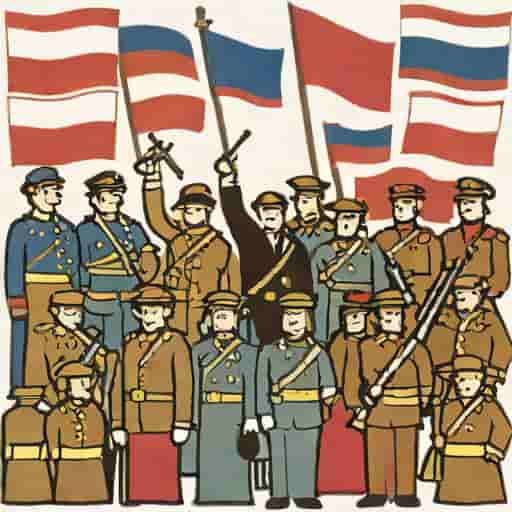
The rise of socialism in Europe during the late 19th and early 20th centuries was a response to the rapid industrialization, urbanization, and economic inequality that characterized the continent. Workers faced long hours, unsafe working conditions, and minimal wages, while industrialists and landowners accumulated wealth and power. Socialism emerged as an ideology that advocated for collective ownership of resources, equitable distribution of wealth, and the protection of labor rights. Across Europe, socialist movements began organizing political parties, trade unions, and workers’ councils to challenge the prevailing capitalist structures. This ideological wave significantly influenced the course of European history, culminating in revolutionary movements, including the Russian Revolution of 1917, which would change the global political landscape.
The Origins of Socialism in Europe
Socialism in Europe can trace its intellectual roots to the early 19th century, influenced by thinkers like Karl Marx, Friedrich Engels, and other social theorists who critiqued the inequalities produced by capitalism. Marx and Engels, in particular, argued that class struggle was the driving force of historical development and that the working class, or proletariat, should unite to overthrow the bourgeoisie, the owners of production. This foundational theory inspired socialist movements across Europe, from the industrial heartlands of Britain and Germany to the agrarian societies of Eastern Europe.
Key Principles of European Socialism
- Collective ownership of the means of production, including factories, land, and natural resources.
- Economic planning to ensure fair distribution of wealth and reduce inequality.
- Protection of workers’ rights, including fair wages, reasonable working hours, and safe working conditions.
- Political representation of the working class through socialist parties and unions.
- Promotion of social welfare programs to support education, healthcare, and housing.
The spread of socialist thought varied by region, often reflecting local economic and political conditions. In Western Europe, socialism became intertwined with parliamentary politics, leading to the formation of socialist and labor parties that sought incremental reforms. In contrast, Eastern European and Russian contexts, marked by autocracy and widespread peasant unrest, fostered more radical and revolutionary approaches to socialism.
Socialism and Labor Movements in Europe
Industrialization in Europe created a new urban working class that faced exploitation and poor living conditions. Socialist parties capitalized on this discontent by organizing strikes, protests, and labor unions to demand better wages, safer workplaces, and social protections. Germany, Britain, and France witnessed the rise of significant socialist and labor parties, with leaders advocating for workers’ rights and legislative reforms.
Influential Socialist Movements
- The German Social Democratic Party (SPD) became one of the most powerful socialist parties in Europe, pushing for workers’ rights within a parliamentary system.
- In Britain, the Labour Party emerged from trade union movements, promoting socialism alongside parliamentary democracy.
- France saw socialist parties engaging in coalition politics to influence labor laws and social reforms.
- Eastern Europe and Russia, under oppressive regimes, experienced underground socialist networks and revolutionary organizations, often operating secretly due to state repression.
European socialism, particularly in industrialized nations, often sought gradual reform rather than immediate revolution. However, the conditions in Russia differed sharply, where peasants made up the majority and faced severe poverty under Tsarist rule, setting the stage for revolutionary upheaval.
The Russian Revolution and the Rise of Soviet Socialism
The Russian Revolution of 1917 marked a turning point in global history and was heavily influenced by socialist ideology. Unlike Western Europe, where socialism developed largely within legal and parliamentary frameworks, Russia’s socialists faced an autocratic Tsarist regime that repressed political dissent. Socialist movements in Russia, including the Bolsheviks led by Vladimir Lenin, aimed for a radical overthrow of the monarchy and the establishment of a workers’ state based on Marxist principles.
Causes of the Russian Revolution
- Widespread poverty and inequality among peasants and urban workers.
- Political repression under the Tsarist autocracy, limiting freedoms and civil rights.
- Economic hardship exacerbated by Russia’s involvement in World War I, leading to food shortages and inflation.
- The influence of Marxist ideology, which advocated for the overthrow of oppressive capitalist and feudal structures.
- Failure of moderate reform movements to address systemic inequalities.
The February Revolution of 1917 initially led to the abdication of Tsar Nicholas II and the establishment of a provisional government. However, dissatisfaction with continued war efforts and economic instability fueled the October Revolution, in which the Bolsheviks seized power. They established a socialist state, nationalizing industry and land, and introducing radical reforms to redistribute wealth and eliminate class distinctions.
Impact of Socialism in Europe Post-Revolution
The success of the Russian Revolution inspired socialist and communist movements across Europe, leading to political instability in some countries and the formation of socialist governments in others. European socialists debated between revolutionary and reformist approaches, influenced by the Bolsheviks’ success. In countries like Germany and Hungary, socialist uprisings emerged but were often suppressed. Meanwhile, in Scandinavia and Western Europe, socialist parties gained legitimacy through elections and reforms, promoting welfare states and labor protections.
Legacy of Socialist Ideas
- Increased awareness of workers’ rights and labor protections throughout Europe.
- Expansion of social welfare systems, including healthcare, education, and pensions.
- Political debates over socialism versus capitalism, influencing party systems and electoral politics.
- Inspiration for revolutionary movements and communist parties in Europe and beyond.
- Long-term shaping of economic policies aimed at reducing inequality and protecting the working class.
Socialism’s influence in Europe thus became twofold inspiring radical revolutionary movements like the Russian Revolution, and driving gradual reformist policies in more democratic societies. These dual impacts continue to influence European politics and economics today.
Socialism in Europe emerged as a response to the inequalities of industrialization and quickly became a powerful political and social force. While Western European countries pursued socialist goals largely through reform and parliamentary engagement, Russia experienced a radical revolution that led to the creation of a socialist state. The Russian Revolution of 1917 demonstrated the potential of socialist ideology to transform societies, inspiring movements across Europe and the world. Over time, European socialism evolved into diverse forms, from revolutionary communism to social democracy, leaving a lasting impact on labor rights, social welfare, and political discourse. The interplay between socialism in Europe and the Russian Revolution highlights the broad influence of socialist thought on 20th-century history and its ongoing relevance in contemporary social and economic debates.