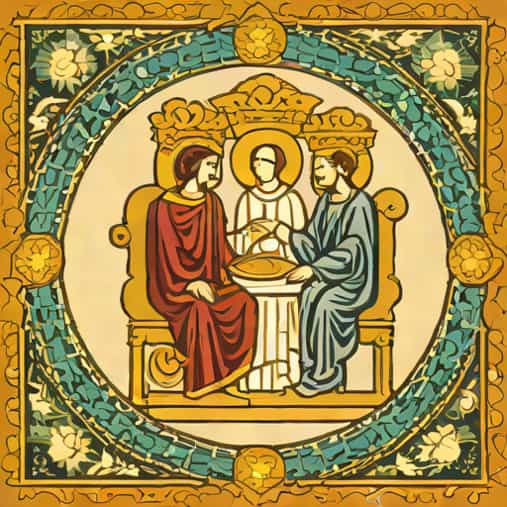
The mosaic known as the Court of Empress Theodora is one of the most discussed artworks from the Byzantine period. Located in the Basilica of San Vitale in Ravenna, Italy, this mosaic attracts attention not only because of its beauty, but also because of its deep political, religious, and cultural meaning. For many viewers, the artwork raises questions about power, gender, faith, and imperial authority. Understanding the court of Empress Theodora mosaic meaning helps us see how art was used as a visual language in the early medieval world.
Historical Background of Empress Theodora
Empress Theodora was the wife of Emperor Justinian I, one of the most powerful rulers of the Byzantine Empire in the 6th century. She came from a modest background and rose to become one of the most influential women in imperial history. Theodora was known for her intelligence, political skill, and strong involvement in state affairs.
During her time, the Byzantine Empire sought to present itself as the rightful continuation of the Roman Empire. Art played an essential role in shaping this image. The mosaic of the Court of Empress Theodora was created during this period, reflecting both her personal authority and the broader ambitions of the empire.
Location and Artistic Context
The Court of Empress Theodora mosaic is located on the south wall of the apse in the Basilica of San Vitale. It is positioned opposite the mosaic of Emperor Justinian and his court. This placement is intentional and meaningful. Together, the two mosaics form a visual statement about imperial power, balance, and divine authority.
The basilica itself was not the main cathedral of Ravenna but an important religious site. The use of elaborate mosaics inside the church reflects the Byzantine belief that sacred spaces should mirror the glory of heaven.
Visual Description of the Mosaic
The mosaic shows Empress Theodora standing at the center of her court, surrounded by attendants and guards. She is dressed in richly decorated imperial robes, with jewels and elaborate patterns. A halo surrounds her head, indicating her sacred status.
Theodora holds a golden chalice, which is believed to be a gift for the Eucharist. Behind her is an architectural backdrop suggesting a palace or sacred space. The figures around her are arranged carefully, creating a sense of order and hierarchy.
Symbolism in the Court of Empress Theodora Mosaic
The court of Empress Theodora mosaic meaning lies largely in its symbolism. Every detail, from clothing to posture, communicates a message.
- The halo represents divine approval and sacred authority.
- The chalice symbolizes her role in supporting the Church.
- The rich garments reflect imperial wealth and power.
- The attendants emphasize her status as ruler, not merely as a wife.
The mosaic presents Theodora as both a political leader and a religious figure, blending secular and spiritual power.
Political Meaning and Imperial Propaganda
One important aspect of the court of Empress Theodora mosaic meaning is its political message. The artwork serves as imperial propaganda. By depicting Theodora with a halo and sacred objects, the mosaic suggests that her authority comes directly from God.
This visual strategy reinforces the Byzantine idea of the emperor and empress as God’s representatives on earth. Even though Theodora is shown in a church setting, her presence reminds viewers that the empire and the Church are closely connected.
Religious Interpretation
Religion plays a central role in interpreting the mosaic. Theodora’s chalice indicates her participation in the sacred ritual of the Eucharist. Although women did not perform priestly duties, this image places her within the sacred narrative of the Church.
The mosaic suggests that imperial patronage is essential to religious life. Theodora is not shown as passive; instead, she actively brings an offering, symbolizing her role in protecting and supporting Christianity.
Gender and Power in Byzantine Art
The mosaic is especially significant when considering the role of women in Byzantine society. Female rulers were rare, yet Theodora is presented with dignity and authority equal to that of her husband.
The court of Empress Theodora mosaic meaning includes a strong statement about female power. Her upright posture, direct gaze, and central position challenge modern assumptions about women’s roles in early medieval politics.
At the same time, her femininity is not hidden. The luxurious clothing and jewelry emphasize her identity as an empress, blending traditional gender symbols with political authority.
Comparison with the Mosaic of Emperor Justinian
The mosaic of Emperor Justinian, located opposite Theodora’s mosaic, helps clarify its meaning. Justinian is shown with clergy and soldiers, emphasizing his roles as ruler and defender of the faith.
Theodora’s mosaic complements this by highlighting ceremonial and spiritual authority. Together, they create a unified image of imperial rule. This balance suggests that the stability of the empire depends on both masculine and feminine forms of power.
Artistic Style and Byzantine Aesthetics
The mosaic reflects typical Byzantine artistic features. Figures appear flat and stylized rather than naturalistic. Gold backgrounds create a timeless, heavenly atmosphere.
This style is not meant to represent everyday reality. Instead, it communicates spiritual truth and eternal authority. Understanding this helps viewers grasp the deeper court of Empress Theodora mosaic meaning beyond surface beauty.
Historical Debates and Interpretations
Scholars continue to debate aspects of the mosaic. Some argue that Theodora may never have visited Ravenna, making the image symbolic rather than literal. Others focus on the political motivations behind the artwork.
Despite these debates, there is agreement that the mosaic reflects how the Byzantine court wanted to be seen. It offers insight into ideals of leadership, faith, and social order.
Why the Mosaic Still Matters Today
The Court of Empress Theodora mosaic remains relevant because it shows how art can shape identity and power. It reminds modern viewers that images are not neutral; they communicate values and beliefs.
For historians, the mosaic is a valuable source of information about Byzantine society. For general audiences, it offers a powerful visual story of a woman who shaped history.
The court of Empress Theodora mosaic meaning goes far beyond decorative art. It represents a carefully constructed image of authority, faith, and imperial identity. Through symbolism, composition, and placement, the mosaic presents Theodora as a ruler chosen by God and essential to the empire’s stability. By understanding its historical, religious, and political context, we gain a deeper appreciation of how Byzantine art communicated power and belief in a world where images spoke as loudly as words.