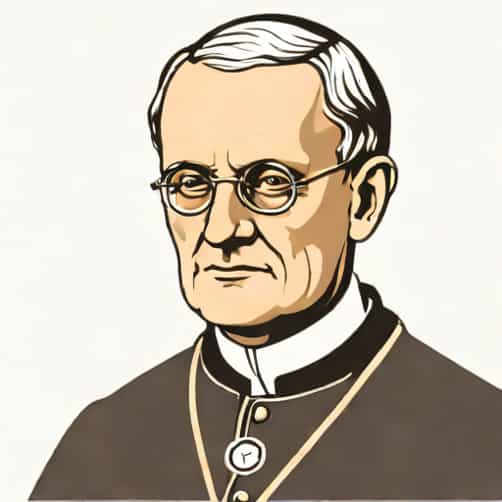
Gregor Mendel, often referred to as the father of modern genetics, made groundbreaking contributions to science that laid the foundation for our understanding of heredity and the principles of inheritance. Through meticulous experiments with pea plants in the mid-19th century, Mendel discovered patterns in how traits are passed from one generation to the next. His work established fundamental laws of inheritance, including the concepts of dominant and recessive traits, segregation, and independent assortment. Mendel’s research, initially overlooked, eventually revolutionized biology, shaping genetics, agriculture, and medicine. Understanding Mendel’s contributions helps us appreciate the scientific principles that govern heredity and continue to influence contemporary genetic research.
Early Life and Scientific Background
Gregor Mendel was born in 1822 in Heinzendorf, Austria (now part of the Czech Republic). From a young age, he showed an aptitude for mathematics and natural sciences, which later informed his experimental approach to biology. Mendel joined the Augustinian Abbey in Brno, where he pursued studies in theology and science. His education included extensive training in botany, physics, and statistics, providing him with the analytical skills necessary for his later experiments. Mendel’s unique combination of scientific curiosity and rigorous methodology allowed him to approach biological questions systematically, a hallmark of his contribution to genetics.
Experiments with Pea Plants
Mendel’s most famous experiments involved cross-breeding pea plants (Pisum sativum) to observe how traits such as flower color, seed shape, and pod color were inherited across generations. He chose pea plants because they had easily distinguishable traits, a short generation time, and the ability to self-pollinate or cross-pollinate. Mendel meticulously recorded data over several generations, analyzing thousands of plants to ensure accurate results. His careful documentation and mathematical approach were unprecedented in biological studies at the time.
Principles of Inheritance
Mendel’s work led to the formulation of several key principles that underpin modern genetics. These principles explain how traits are transmitted from parents to offspring and provide a framework for understanding hereditary patterns.
Law of Segregation
The law of segregation states that each organism carries two alleles for each trait, and these alleles separate during the formation of gametes, so that each gamete receives only one allele. This principle explains why offspring may exhibit traits that are not immediately visible in the parents but can reappear in subsequent generations. Mendel’s observation of dominant and recessive traits in pea plants was central to identifying this law.
Law of Independent Assortment
The law of independent assortment describes how alleles for different traits segregate independently during gamete formation. This means that the inheritance of one trait does not affect the inheritance of another, allowing for a variety of genetic combinations. Mendel demonstrated this by studying plants with multiple traits, observing that traits such as seed shape and flower color were inherited independently of each other. This principle provided a foundational understanding of genetic variation.
Dominant and Recessive Traits
Mendel observed that some traits appear in offspring even when only one parent contributes them, while others remain hidden unless both alleles are present. He described these as dominant and recessive traits. For example, in his experiments, yellow seeds were dominant over green seeds, meaning that a plant with one yellow allele and one green allele would display yellow seeds. Recognizing dominant and recessive patterns allowed scientists to predict inheritance outcomes and laid the groundwork for Punnett squares and genetic probability models.
Impact on Modern Genetics
Mendel’s work, initially published in 1866, went largely unnoticed during his lifetime. It was rediscovered around 1900 by scientists Hugo de Vries, Carl Correns, and Erich von Tschermak, who confirmed Mendel’s findings and helped establish the field of genetics. Today, Mendel’s principles are fundamental to the study of biology, from understanding human inheritance patterns to exploring genetic diseases and plant breeding.
Applications in Agriculture
Mendel’s discoveries have had a profound impact on agriculture, particularly in the selective breeding of crops and livestock. By understanding how traits are inherited, farmers and scientists can develop plants with desirable characteristics, such as higher yield, disease resistance, or improved nutritional content. Similarly, livestock breeding has benefited from Mendelian principles, enabling the production of animals with favorable traits while maintaining genetic diversity.
Medical and Scientific Contributions
In medicine, Mendel’s work underpins the study of genetic disorders and inheritance patterns in humans. Genetic counseling, prenatal testing, and research into hereditary diseases rely on the understanding of dominant, recessive, and co-dominant traits. Additionally, modern fields such as molecular genetics and genomics build on Mendelian foundations, using DNA analysis to explore gene function, mutation, and expression. His contributions continue to guide research in biotechnology, personalized medicine, and genetic engineering.
Mendel’s Methodological Legacy
Beyond the specific laws he formulated, Mendel’s methodological approach influenced the scientific community. His emphasis on careful observation, precise record-keeping, and statistical analysis set a standard for empirical research in biology. By combining mathematics with experimentation, Mendel demonstrated the importance of quantitative approaches in understanding complex biological processes. This methodological rigor remains a model for researchers in genetics and related fields today.
Influence on Scientific Thinking
Mendel’s work challenged the prevailing ideas of blending inheritance, which suggested that traits from parents mix in offspring like colors in paint. Instead, his experiments showed that inheritance follows predictable patterns governed by discrete units, later understood as genes. This shift in thinking transformed biological sciences, influencing Darwinian evolutionary theory, population genetics, and modern evolutionary biology. Mendel’s insights helped bridge experimental biology with theoretical genetics, providing a foundation for understanding evolution at the molecular and organismal levels.
Recognition and Honors
Although Mendel did not receive widespread recognition during his lifetime, his contributions have since been acknowledged globally. Institutions, awards, and educational programs celebrate his role as a pioneer in genetics. Mendel’s work is taught in schools and universities as a cornerstone of biology, emphasizing the importance of experimentation, observation, and analytical reasoning. Statues, memorials, and scientific societies honor his legacy, ensuring that future generations recognize the enduring value of his discoveries.
Educational Impact
Mendel’s experiments are a standard part of biology curricula worldwide. Students learn to apply his principles to understand inheritance, predict genetic outcomes, and appreciate the scientific method. By studying Mendel, learners develop critical thinking skills and a foundation for exploring more advanced topics in genetics, molecular biology, and biotechnology.
The contribution of Gregor Mendel to science cannot be overstated. Through his careful experiments with pea plants, he established the principles of inheritance, including the laws of segregation and independent assortment, as well as the concept of dominant and recessive traits. Mendel’s work laid the groundwork for modern genetics, influencing agriculture, medicine, and biological research. His methodological rigor and analytical approach continue to inspire scientific inquiry, making him a central figure in the history of biology. By understanding Mendel’s contributions, we gain insight into the mechanisms that govern life, the predictable patterns of inheritance, and the potential for scientific discovery that builds upon foundational knowledge.