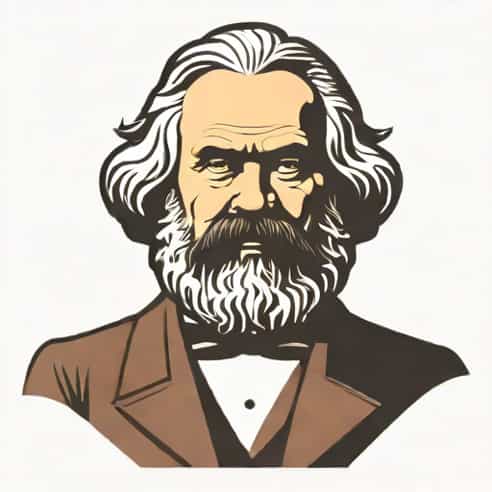
Karl Marx was a revolutionary thinker whose ideas have influenced political, social, and economic thought for more than a century. He was deeply concerned with the inequalities and injustices he observed in 19th-century Europe, particularly the exploitation of workers during the Industrial Revolution. Marx’s critique of society was not limited to theoretical ideas; he sought real, systemic change. His work focused on analyzing class struggle, the relationship between capital and labor, and the dynamics of power in capitalist societies. Central to Marx’s philosophy was the belief that the existing social and economic order was inherently oppressive, and he wanted to overthrow structures that perpetuated inequality and exploitation.
The Foundation of Marx’s Thought
Marx’s ideas were grounded in a thorough analysis of history and economics. He believed that society progresses through stages, each defined by the dominant mode of production. In his view, history is shaped by the conflict between classes, particularly between those who own the means of production and those who sell their labor. This framework, known as historical materialism, formed the basis for his argument that the capitalist system was fundamentally exploitative and destined to be overthrown. Marx observed that workers, or the proletariat, were systematically deprived of the value of their labor, while the bourgeoisie accumulated wealth and power.
The Concept of Class Struggle
Class struggle was central to Marx’s analysis. He argued that society is divided into two main classes the bourgeoisie, who control capital and resources, and the proletariat, who must work for wages. According to Marx, this relationship is inherently antagonistic because the interests of these classes are opposed. The bourgeoisie seeks to maximize profit, often at the expense of workers’ well-being, while the proletariat seeks fair compensation and better living conditions. Marx believed that this struggle would intensify over time, eventually leading to a revolutionary overthrow of the capitalist system.
What Marx Wanted to Overthrow
Marx specifically wanted to overthrow the capitalist system. He saw capitalism as a social and economic structure that prioritizes profit over human needs, creating vast inequalities and alienation among workers. Under capitalism, labor is commodified, and the majority of people are forced to sell their labor in exchange for survival. Marx argued that this system leads to exploitation, poverty, and social instability. By overthrowing capitalism, Marx envisioned a society in which the means of production would be collectively owned and wealth and resources would be distributed more equitably.
Economic Exploitation and Alienation
Marx’s critique of capitalism included the concepts of exploitation and alienation. Exploitation occurs when workers produce more value than they receive in wages, with the surplus being appropriated by the owners of capital. Alienation refers to the disconnection workers feel from the products of their labor, from each other, and from their own human potential. According to Marx, these conditions are not accidental but are inherent features of capitalist production. By overthrowing this system, he hoped to create a society where individuals could fully develop their capabilities and engage in meaningful work.
The Role of Revolution
For Marx, the overthrow of capitalism would not be gradual but revolutionary. He believed that the proletariat, once aware of their collective oppression, would unite and seize control of the state. This revolution would dismantle existing power structures and abolish private ownership of the means of production. Marx’s vision was not limited to economic reform; it involved a complete transformation of society, including political, social, and cultural institutions. The ultimate goal was a classless society where exploitation and inequality were eliminated.
Stages After the Overthrow
After the overthrow of capitalism, Marx proposed a transitional period known as the dictatorship of the proletariat. During this stage, the working class would organize society to prevent the resurgence of capitalist structures. Property would be socialized, and production would be planned to meet human needs rather than generate profit. Eventually, this period would lead to a stateless, classless society where people could live cooperatively, free from oppression. Marx believed that this vision was the logical outcome of class struggle and historical development.
Marx’s Influence on Political Movements
Marx’s ideas have inspired numerous political movements and revolutions around the world. From the Russian Revolution to labor movements in Europe and Latin America, Marxist theory has provided a framework for challenging existing power structures. These movements sought to implement aspects of Marx’s vision, often focusing on the redistribution of wealth, nationalization of industries, and social welfare programs. While the outcomes and interpretations have varied, the core idea remains that systemic change is necessary to address economic and social injustice.
Criticism and Debate
Despite its influence, Marx’s idea of overthrowing capitalism has faced significant criticism. Critics argue that attempts to implement Marxist principles have sometimes led to authoritarianism, economic inefficiency, or social disruption. Others contend that capitalism, when regulated, can coexist with social welfare programs that reduce inequality without requiring a revolutionary overthrow. Nevertheless, Marx’s analysis of class struggle, exploitation, and economic inequality continues to resonate, particularly in discussions about wealth concentration and workers’ rights in the modern global economy.
Modern Relevance
In today’s world, the question of whether an object, policy, or institution is obtrusive can be compared metaphorically to Marx’s critique of capitalism. Just as Marx wanted to overthrow structures that were inherently unfair, contemporary society continues to debate the fairness of economic systems, corporate power, and wealth distribution. Concepts like income inequality, labor rights, and corporate influence on politics echo the issues Marx identified in the 19th century. While the methods of change may differ, the underlying principle of challenging systemic injustice remains relevant.
Educational and Philosophical Legacy
Marx’s work has had a lasting impact on education, philosophy, and social sciences. His theories encourage critical thinking about power, economics, and society. By studying Marx, students and scholars gain tools to analyze the roots of social inequality and explore alternative systems. Understanding what Marx wanted to overthrow provides insight into ongoing debates about fairness, justice, and human potential. It encourages reflection on how societal structures shape human experience and highlights the importance of collective action in addressing systemic issues.
Karl Marx wanted to overthrow the capitalist system because he saw it as a structure that inherently exploited workers and created vast social inequalities. His vision of a classless society, free from economic oppression, has inspired political, social, and intellectual movements worldwide. By analyzing class struggle, economic exploitation, and alienation, Marx provided a framework for understanding systemic injustice and imagining transformative change. While interpretations and implementations have varied, the core idea of challenging oppressive systems continues to influence contemporary discussions on justice, equality, and human rights. Marx’s work reminds us that societal change requires both critical analysis and action, aiming toward a world where resources, power, and opportunities are more equitably shared.